
Let’s talk about the elephant in the room. Youth baseball in Texas has turned into a financial battle that many families didn’t see coming. Parents face rec league costs of $200-400 each season. But that’s just the starting point.
For competitive teams, select team expenses can reach $3,000-5,000 a year. And that’s before adding in the hidden costs. These include hotel stays at $150 per night, uniforms that need to be replaced often, and expensive private coaching.
The Aspen Institute has a blunt message: only 38% of kids aged 6-12 play team sports regularly. Access to sports is now tied to family income. This has made baseball a pricey, exclusive club.
But there’s a secret that’s not shared at registration. Financial aid programs are available. They offer grants, fee waivers, and youth baseball scholarships that families need but often don’t find.
The real question isn’t if help is out there. It’s why we’re not talking about it.
Where to look YMCA waivers city leagues Rangers Academy nonprofits and local foundations
Getting your kid into youth baseball isn’t just about the game. It’s about finding the money to play. Registration fees can feel like a car payment. So, where do you start?
First, check with your local YMCA. They offer YMCA financial assistance through various programs. You just need to ask about fee waivers and scholarships.
But, these programs are not well-known. Many YMCA programs have funds that go unused because families don’t ask.
Community baseball leagues in city parks also offer help. They have scholarship funds hidden in their budgets. These funds are there, but you won’t see them on registration forms.
In Texas, the Texas Rangers Baseball Foundation supports youth baseball and softball. They help with equipment, field improvements, and more, not just scholarships for players.
If you’re part of a league or starting a nonprofit team, reach out to them. The Rangers Youth Academy in Dallas offers free instruction and equipment to those in need. It shows that top coaching doesn’t have to cost a lot.
There are also national and regional nonprofits helping Texas families:
- All Kids Play gives grants to families for sports, up to $350 per sport per session
- Cardinals Care Foundation funds youth sports in specific Texas areas
- CSX Community Service Grants help organizations in CSX areas
- Zeffy Grant Finder lets you filter by state, county, city, and deadlines
All Kids Play is special because it helps both organizations and families. You can get funding for your league and also apply for help for your child.
Local community foundations are another great source of funding. Texas has many, like the Dallas Foundation and the Houston Endowment. They have grant programs for youth sports that are often overlooked.
Why don’t they advertise? They’re already flooded with applications. You need to be proactive, not just wait for opportunities to come to you.
| Funding Source | Type of Assistance | Geographic Focus | Application Timing |
|---|---|---|---|
| YMCA Financial Assistance | Fee waivers, sliding scale | Local branch service area | Year-round, rolling basis |
| Texas Rangers Foundation | Equipment, field grants, program support | Statewide Texas | Annual cycles, check website |
| All Kids Play | Individual grants up to $350 per sport | National, including Texas | Four applications per year per child |
| City Parks & Recreation | Scholarships, reduced fees | Municipal service area | Typically at registration |
| Local Community Foundations | Youth sports grants, organizational support | County or regional | Varies by foundation |
Organizations with the most money often don’t advertise much. Start with your local YMCA, city parks, and county foundation. Then, look at statewide programs like the Rangers Foundation.
Funding is out there. The challenge is knowing where to look and asking the right questions. That’s the real first step in this game.
Eligibility documentation income school lunch service area GPA if any
Knowing what documents grant committees want is key. It’s what sets families who get funded apart from those who don’t. The gap between needing financial help and proving it can seem huge. But, once you understand what’s needed, you can unlock many fee waivers and scholarships.
Most youth baseball financial aid programs need income verification. They check if your family meets their income level. They look for recent pay stubs, last year’s tax return, or current government benefit statements.
The All Kids Play program uses U.S. Department of Health and Human Services data to set income guidelines. Families earning less than 60% of estimated state median income get full grants. Those earning less than 100% get partial grants, covering 50% of costs.

Smart families save time by using free lunch qualification as a shortcut. If your child gets free or reduced-price lunch, you qualify for most youth sports aid. It’s like a golden ticket that saves you from extra paperwork.
Schools have already checked your income against federal poverty guidelines. Grant administrators trust this process. So, you can skip the paperwork and get approved quickly.
Service area requirements add another layer to eligibility. Programs target specific ZIP codes or school districts with economic need. All Kids Play, for example, looks for areas with high low-income student percentages or low average household incomes.
| Document Type | What’s Required | Verification Strength | Processing Time |
|---|---|---|---|
| Pay Stubs | Last 2-3 months from all employed household members | High – shows current income | Immediate |
| Tax Returns | Previous year’s complete 1040 with all schedules | Very High – IRS verified | 1-2 days to locate |
| Benefit Statements | Current SNAP, TANF, SSI, or similar documentation | High – government verified | Immediate to 1 week |
| School Lunch Approval | Letter or portal screenshot showing free/reduced status | Very High – pre-screened | Same day |
You can find your school district’s poverty data on the Texas Education Agency website. It takes about five minutes and helps you know if your area qualifies before applying.
What about GPA requirements? Most community-level baseball programs focus on participation, not grades. Some elite teams or scholarships might ask for grades, but recreational leagues usually don’t. They want to keep kids active, not create barriers.
The 501(c)(3) question often confuses families and small coaching groups. Traditional grants often require nonprofit status. But, you can use fiscal sponsors or partnerships with established nonprofits. A local youth foundation or community center can accept grant funds for your program.
My advice is to treat documentation assembly like spring training. Do it once, do it right, and keep copies. The eligibility packet you create for one application can be used for many others. A little paperwork can fund an entire season if you approach it as a portfolio.
The documentation process might feel invasive. But, it’s the price to access thousands of dollars in support. The programs asking for this information are ensuring funds go to families in need. This verification protects the system that helps your kid play ball.
Fundraising playbook sponsor letters clinics raffles and matching gifts
Teams that do well have a solid fundraising plan. While nonprofit grants are key, they also look for other ways to make money. It’s not just about selling baked goods anymore.
Today’s fundraising needs a mix of strategies. It’s like building a baseball team. You need players who hit home runs, those who get on base, and reliable players. No one strategy can do it all.
Let’s explore the effective strategies.
Sponsor Letters That Open Wallets
Most teams write letters that sound like they’re begging for help. But corporate sponsorships work better when you show it’s a smart investment.
Your letter should have four key parts. First, clearly state your mission and who you help. Then, share data about the families you serve, like how many are low-income.
Next, be specific about what you need, like “$2,500 for field equipment.” This beats vague requests.
Last, explain how the sponsor will benefit. Offer things like logo placement, game announcements, and social media shoutouts. Local businesses want to be seen as community supporters.
Baseball Clinic Fundraisers With Double Value
Running baseball clinics is a win-win. They bring in money and help kids improve their skills. Partner with college players to teach kids on weekends.
Charge $50 per kid for a clinic. With 30 kids, you make $1,500. After paying the instructors, you’re left with over $1,000.
Parents see it as a good deal. They’re paying for valuable lessons, not just donating. This mindset makes a big difference.
Raffles and Auctions That Generate Buzz
Generic prizes don’t excite anyone. But unique items like sports memorabilia or restaurant packages create excitement. They lead to real bidding wars.
Think about these high-value raffle prizes: throwing the first pitch, private lessons, or behind-the-scenes tours. They cost little but bring in a lot of money.
The key is to partner with local businesses for prizes. Then, promote their generosity online. Everyone benefits.
Matching Gift Programs: The Hidden Goldmine
Many Texas employers offer matching gift programs that double donations. But few teams take advantage of this.
Here’s how it works. If you’re a 501(c)(3) or have a fiscal sponsor, parents can donate and get their employer to match it. This doubles their donation without costing them anything extra.
The catch is you need to be a 501(c)(3) or partner with one. Getting the paperwork done pays off after just three matched donations.
Building Your Revenue Mix
These strategies work together, not against each other. The Zeffy guide says to use real numbers and stories, not vague promises. This advice applies to all your fundraising efforts.
Keep track of everything. Companies often support the same causes year after year. Once you get a grant or sponsor, renew it with updated data showing your impact.
| Fundraising Method | Revenue Potentia | Time Investment | Sustainability |
|---|---|---|---|
| Corporate Sponsorships | $500-$5,000 per sponsor | High initial, low renewal | Excellent if maintained |
| Baseball Clinic Fundraisers | $1,000-$2,000 per event | Medium (weekend commitment) | Good with regular scheduling |
| Raffles and Auctions | $500-$3,000 per event | Medium (prize procurement) | Moderate (donor fatigue risk) |
| Matching Gift Programs | Doubles existing donations | Low (mainly administrative) | Excellent (repeatable annually) |
Successful teams don’t rely on just one way to make money. They mix matching gift programs, sponsorships, events, and grants. This approach ensures steady funding, unlike the feast-or-famine cycle that many teams face.
Start with one strategy this month. Master it, then add another. In six months, you’ll have a fundraising machine that boosts your program’s finances. And you’ll control the timing, unlike waiting for grants.
Equipment help bat and glove drives refurbish programs and buy back groups
Every youth baseball league has a secret network. It’s about bat drives, glove refurbishment, and gear swaps. This network is mostly word-of-mouth, helping families find affordable equipment.
Buying cheap gear can be expensive in the long run. Families spend more because cheap items break easily. For example, a $40 glove might need to be replaced after one season.
But, a well-maintained used glove is always better than cheap ones.
Community-Based Equipment Drives and Donation Programs
At the end of the season, equipment drives collect gear from families. This includes bats and gloves that kids have outgrown. These drives help other families get the gear they need for free.
Organizations like Play It Again Sports help families buy, sell, and trade gear. But, community drives are the best way for new families to get started. Team coordinators often organize big collections of equipment.
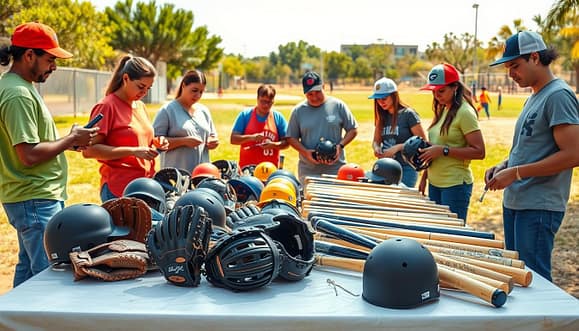
In Texas, some leagues have glove refurbishment programs. They fix up used gloves and give them to families who need them. A refurbished glove is often better than a new, cheap one.
Informal Networks and Equipment Swaps
Buy-back groups and swaps create their own economies. Facebook groups and league message boards help families trade equipment. This way, everyone saves money.
End-of-season swap events bring families together. They exchange equipment, saving money and helping each other out. These events are based on trust and sharing.
The secondary market has a lot of value. You just need to know where to look.
Foundation and Retail Sports Equipment Grants
Foundations and retailers give grants for youth sports equipment. The Dick’s Sporting Goods Foundation offers grants from $5,000 to $25,000. The application is simple, focusing on what you need and how many kids you serve.
The LA84 Foundation supports sports equipment in Southern California. Angels Baseball Foundation and other MLB teams also help. These grants are easier to get than big program grants.
Local sporting goods stores also give back. They have donation drives and discounts for qualifying organizations. Talking to a store manager can reveal these opportunities.
Equipment Access Options Comparison
| Access Method | Typical Cost | Application Complexity | Best For |
|---|---|---|---|
| Community Equipment Drives | Free | None (just ask) | Families needing immediate gear |
| Glove Refurbishment Programs | Free to $20 | Minimal (contact league) | Players wanting quality used gloves |
| Sports Equipment Grants (Dick’s, LA84) | $5,000-$25,000 per org | Low (1-page letter) | Leagues and nonprofit programs |
| Buy-Back Groups & Swaps | $10-$100 depending on item | None | Families upgrading as kids grow |
The Distribution Problem Disguised as Scarcity
Equipment poverty is not a natural problem. It’s a distribution problem that looks like scarcity. Garages in Texas are full of unused baseball gear.
The real challenge is getting this gear to families who need it. Equipment drives, refurbishment programs, and swaps solve this problem. They make sure everyone has access to the gear they need.
Coaches and league administrators can create equipment closets. This gives families immediate access to gear. Parents can also swap outgrown gear at the end of the season. This way, they get what they need for next year without spending more money.
The gear is already out there. You just need to know where to find it.
Transportation solutions carpools vouchers public transit safety
Getting your kid to the field can cost more than the uniform. When a team coach calls with good news, they often forget to mention the travel costs. For a Texas family, traveling to practice and tournaments can add up to 200-plus miles every week.
At today’s gas prices, that’s $40-60 weekly. Across the season, it’s $2,000 annually in fuel costs alone. Add vehicle maintenance and emergencies, and costs can reach $3,000. This cost is often hidden in program brochures.
For families without cars, baseball can seem unreachable, even with scholarships. The waiver doesn’t help if you can’t get to the field. So, what works?
Carpooling is a good solution, but it needs planning. Leagues should treat transportation as seriously as practice planning. They can use ZIP codes and schedules to match families.
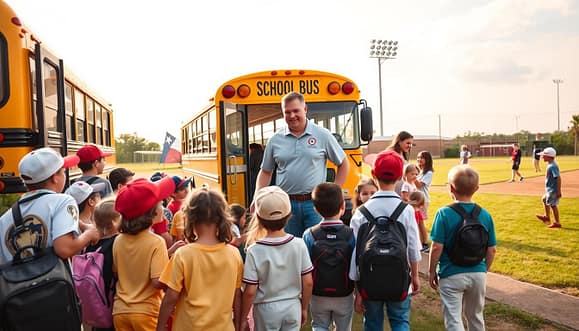
Gas vouchers are another help. Some Texas programs give mileage reimbursement to families. All Kids Play grants cover transportation costs. A $20 gas card can help a lot.
In cities, public transit can be a good option. Leagues can schedule practices near bus or rail lines. While it’s not perfect, it’s better than missing practices.
Some Texas programs have started van services like school buses for sports. They run routes for practices and games. This is funded by grants, sponsorships, and family contributions.
When looking at youth baseball scholarships, ask about transportation help. Some programs already offer it. Others might if families ask. It’s about making sports accessible to all.
Document your costs if needed. Show how transportation is a big hidden expense. Research shows that sports access is linked to family income, with transportation being a big barrier.
| Transportation Solution | Best For | Typical Cost Reduction | Implementation Effort |
|---|---|---|---|
| Carpool coordination systems | Suburban leagues with clustered families | 50-75% reduction per family | Low – requires ZIP code matching |
| Gas vouchers and mileage reimbursement | Families driving multiple players | $80-160 monthly savings | Medium – needs funding source |
| Public transit with chaperones | Urban areas with good transit access | 60-80% cost reduction | Medium – requires supervision coordination |
| Organized van services | Large programs with consistent routes | 70-90% reduction per family | High – needs vehicle and driver management |
Transportation is the last barrier to sports access. Free registration and donated equipment mean nothing if you can’t get to the field. Solving the logistics problem is key to inclusive youth baseball.
When leagues create scholarships, they should consider transportation costs. Families should also think about travel expenses when choosing teams. The distance to a team can be as important as the cost.
Budget tracker template for families and coaches
Youth baseball has hidden costs. The $300 season fee is just the start. Families can end up spending $2,000 to $5,000 before the season ends.
I’m giving you a baseball budget planning tool. It helps you see all costs before you spend. It’s like a season cost calculator that turns worry into action.
Here’s what you need to track:
- Registration fees – Start with $200-400 for fun leagues to $3,000-5,000 for top teams each year
- Uniforms and team gear – Jersey, pants, socks, hat, and bag cost $150-200
- Personal equipment – A new glove, bat, helmet, and cleats add $200-400
- Training and lessons – Figure out your hourly rate times sessions per month, then season length
- Tournament and travel fees – Entry fees plus hotels, meals, and gas that aren’t mentioned upfront
- Fundraising obligations – Many leagues need you to raise money or time
- Miscellaneous expenses – Team photos, end-of-season parties, coach gifts, and mid-season gear
For each area, use a three-column tracker. It shows the full financial picture:
| Expense Category | Budgeted Cost | Actual Cost | Funding Source |
|---|---|---|---|
| Registration & League Fees | $350 | $350 | 50% scholarship, 50% family |
| Uniforms & Team Gear | $150 | $175 | Fundraising |
| Personal Equipment | $300 | $425 | Grant, donated glove |
| Tournament & Travel | $400 | $680 | Family payment, carpool |
| Training & Lessons | $200 | $240 | Volunteer coach exchange |
This hidden fee tracking helps in many ways. It helps families plan better and find youth baseball scholarships.
You’re not just asking for help anymore. You’re asking for “$680 to cover spring tournament travel costs for a working single parent.”
For coaches and league admins, it’s about real numbers. Imagine saying: “Our families spend $2,400 per season, with travel being 35% of that, affecting 40% of our team.”
The tracker also shows the unpaid labor families do. It’s worth $3,000-5,000 a year, mostly done by middle-class families.
This unpaid work is a big deal. It’s $3,000-5,000 a year that wealthier families don’t think about. But for working-class families, it’s a huge burden.
Get a free template from Zeffy or make your own in Google Sheets. Just tracking your expenses can make a big difference.
When you’re done, your budget tracker is strong evidence for scholarships and grants. It turns your financial worries into data that funders can’t ignore. Plus, it shows patterns, like when to ask for youth baseball scholarships for new gear.
Start tracking now, even if it’s mid-season. Next year’s families will thank you for the plan you’re making today.
Building inclusive teams policies communication and culture
Most youth baseball programs confuse charity with inclusion, and kids notice the difference. I’ve seen coaches start scholarship programs but then ruin them by announcing who gets help at practice. Building genuinely inclusive youth sports requires deliberate structural policies, not just financial aid checks.
Start with universal communication about costs and aid. Every family, regardless of income, should get info about scholarships at registration. Say “We offer flexible payment options for all families” instead of “financial aid for the disadvantaged.” Semantics matter—they’re the difference between accessible and othering.
Your sliding scale fees should be on standard registration forms, not hidden applications. List payment tiers as routine options: full registration, three-quarter rate, half rate, quarter rate. No special forms. No stigma attached to selecting the option your family needs.
Establish team policies that don’t correlate with payment status. Fundraising participation, volunteer requirements, and leadership opportunities must be available to all players. The kid whose family pays full freight shouldn’t get more playing time, better positions, or additional attention than anyone else.
Here’s where team culture building gets real: those patterns emerge unless you explicitly address them. Create operating rules that prevent economic segregation. Announce at the first parent meeting that playing time decisions are based solely on effort, attitude, and skill development—never on financial contribution.
| Exclusive Practice | Inclusive Alternative | Impact on Access |
|---|---|---|
| Team dinners at restaurants | Rotating potlucks and affordable venues | Eliminates $30-50 barrier per family |
| Required fundraising minimums | Optional participation with alternatives | Removes $200-500 pressure point |
| Equipment purchase requirements | Normalized lending library system | Saves families $150-300 annually |
| Weekday afternoon practices only | Transit-accessible scheduling options | Opens access for working families |
Culture-building happens in small moments. Schedule practices accessible by public transit when possible. When organizing team events, assume not everyone can afford extras. Create equipment lending policies that normalize borrowing for anyone who needs a backup glove, not just “needy” families.
Your scholarship communication should be private, confidential, and dignified. Financial assistance applications flow directly to league administrators, not coaches. Protecting privacy isn’t optional—it’s the foundation of respect. Coaches shouldn’t know which families receive aid unless absolutely necessary for logistics.
Understand that the kid who misses practice might be dealing with transportation challenges or work obligations, not lack of commitment. Before assuming attitude problems, ask questions. Before penalizing absences, understand context. That’s not lowering standards—it’s recognizing that access barriers exist outside your control.
For administrators applying for nonprofit grants, your inclusive policies become competitive advantages. Funders seek organizations serving diverse populations with intentional equity practices. Document your sliding scale fees structure, scholarship award numbers, partnerships with Title I schools, and demographic data about families served.
The grant narrative writes itself when you’ve done the actual work. Highlight the number of kids served from low-income families. Showcase your accessible programs and measurable outcomes. Include real numbers plus stories about individual players whose lives changed. Funders care about character development, active kids, and strengthened neighborhoods—prove you deliver those results equitably.
Inclusion isn’t a PR strategy for securing nonprofit grants—it’s an operational framework that makes every policy decision through the lens of access. Then you leverage that authentic commitment to secure funding that sustains the model. That’s how you build programs that last, not feel-good initiatives that collapse when the founding passionate coach moves on.
Success stories programs that bridged the gap
When programs actually bridge the financial gap, the results are clear and undeniable. I’m talking about real kids with documented outcomes, not just inspirational stories.
Take Miguel—real person, name changed for privacy—whose family qualified for free lunch. They lived in an apartment complex thirty miles from the nearest select baseball facility. Miguel had raw talent that coaches noticed immediately.
But his single mom worked two jobs. She couldn’t afford the $3,500 select team fee, much less the gas money for practices three times a week.
His rec league coach connected the family with All Kids Play, which covered registration and equipment through their national grant program. A team parent organized a carpool rotation. Local businesses sponsored tournament fees through targeted fundraising letters.
Miguel’s story isn’t unique—it’s the template that proves the system works when somebody bothers to connect dots. Three years later, Miguel earned a spot in a college prospect showcase, directly traceable to access created by layered fee waivers and community support.
Or consider the South Dallas league that partnered with Rangers Youth Academy to overhaul their entire program. The scholarship impact was immediate and documented:
- Free clinics with professional instruction for 200 kids
- Equipment drives that outfitted families who couldn’t afford $300 starter packages
- Field renovations funded through Texas Rangers Baseball Foundation grants
- Transportation vouchers for families without reliable vehicles
Within two seasons, participation increased 60%. The league became a talent pipeline for high school programs that previously overlooked their players. These aren’t charity cases—they’re market inefficiencies being corrected.
The equipment drive operated by a Fort Worth team mom created something resembling what academic bridge programs do for college access: a systematic intervention with measurable outcomes. She built a lending library of $15,000 worth of donated gear, serving 75 families over three seasons.
The program outcomes told the real story. Data showed that equipment access increased season completion rates by 40%. That evidence, documented in post-season surveys, became the foundation for a successful nonprofit grant application that institutionalized the program with permanent funding.
All Kids Play requires mid-season and post-season surveys about athlete experience. That’s not bureaucratic busywork—it’s how you prove program outcomes to funders who need more than feel-good anecdotes.
| Program Type | Intervention | Families Served | Measurable Impact |
|---|---|---|---|
| All Kids Play Grants | Fee waivers and equipment | National reach, 1000s annually | Increased access for low-income families |
| Rangers Youth Academy | Free instruction and gear | South Dallas community, 200+ kids | 60% participation increase in 2 seasons |
| Fort Worth Equipment Library | Donated gear lending | 75 families over 3 seasons | 40% higher season completion rates |
| Combined Carpool Networks | Transportation solutions | Varies by team/league | Eliminated travel barrier for remote families |
The pattern in every one of these youth baseball success stories follows the same blueprint: somebody identified a specific barrier—cost, transportation, equipment, information—then implemented a targeted solution. They measured the impact. Then they used that evidence to scale the intervention through grants and systematic programs.
Success isn’t inspirational—it’s replicable. The question is whether your league, team, or family will take the first step to access resources that already exist. Or will you continue operating under the false assumption that youth baseball must be economically exclusive?
The gap gets bridged when people stop treating fee waivers and equipment drives as charity and start treating them as infrastructure. Miguel didn’t need a handout. He needed the same access his wealthier peers got by accident of birth.
These programs prove the talent was always there. The market just needed correction.
Contact directory grant calendar and application checklist
The paperwork part. Start with Texas Rangers Baseball Foundation at texasrangers.com/foundation for statewide nonprofit grants. Applications open each fall for the next season. They fund equipment, field upgrades, and program development.
All Kids Play (allkidsplay.org) processes youth baseball scholarships on a rolling basis. Family grants reach $350 per recreational sport, with organizational grants for leagues. Submit at least 30 days before registration closes. That lead time matters more than most applicants realize.
Dick’s Sporting Goods Foundation runs Sports Matter at sportsmatter.org. Their equipment grants target underserved communities year-round. Zeffy Grant Finder offers free searches filtered by Texas zip codes and grant application deadlines without subscription fees.
Your city’s community foundation—Dallas Foundation, Houston Endowment, Austin Community Foundation, San Antonio Area Foundation—maintains local funding resources. Check Parks and Recreation departments for municipal fee waivers. YMCA branches offer sliding-scale programs through direct facility applications.
The application checklist: income verification, residence proof, birth certificate or school records, program details with costs, completed forms, and any required essays. Apply to multiple financial aid contacts simultaneously. Treat this like college admissions, not a single lottery ticket.
One move worth remembering: after any successful grant, ask the program officer what other sources they recommend. That informal guidance often outperforms any published directory.
The funding exists. The applications take hours. The return measures in thousands of dollars and immeasurable opportunities.