

Here’s a secret about youth baseball training: it’s not about knowing too much. It’s about knowing the right stuff. I’ve seen kids become experts on swing mechanics, thanks to social media coaches who often disagree.
The real challenge is creating a program that teaches without making kids robotic. They should know how to barrel a fastball, not just talk about swing mechanics.
The 9–14U age is key for developing movement patterns and decision-making skills. Bad coaching can harm these skills for life. Knowing where and how to practice is vital for skill growth.
Our approach focuses on mechanics development and timing training based on research. We aim to build hitters who can think and act, not just look good in slow-motion.
It’s not just about bat speed. It’s about recognizing a slider at 50 feet and making quick decisions. That’s what matters in the game. Everything else is just a distraction.
Assessment swing audit kinematic checkpoints bat speed and attack angle baseline
Every swing audit starts with a choice. You can chase seventeen angles or focus on three key things. I’ve seen coaches spend forty-five minutes on elbow slot depth, ignoring the athlete’s inability to recognize a changeup.
The assessment phase isn’t about cataloging every biomechanical variable. It’s about finding baseline metrics that predict game performance.
Most swing assessment protocols ignore a key fact. Research shows that focusing on body mechanics makes athletes slower. Yet, we create systems that turn instinctive movements into mechanical checklists.
Objective data is the foundation of a good assessment. Exit velocity shows bat speed and impact quality. Launch angle reveals attack angle tendencies and barrel path. These baseline metrics provide a factual starting point.
But many programs go wrong with “result-based diagnosis.” A hitter pops up, and seventeen mechanical flaws appear. Never mind the swing looked fine—the outcome dictates the diagnosis. This ignores the vast majority of mishits that stem from timing errors, vision failures, or approach mistakes.
| Assessment Type | Primary Focus | Common Mistake | What It Actually Measures |
|---|---|---|---|
| Result-Based | Ball flight outcomes | Diagnosing mechanics from results | Timing and decision quality |
| Visual-Only | Subjective body positions | Overemphasizing aesthetics | Coach preference patterns |
| Technology-Heavy | Every measurable joint angle | Paralysis by analysis | System capability, not player need |
| Objective-First | Bat speed, attack angle, contact ability | Occasionally missing context | Performance capacity and tendencies |
The kinematic checkpoints that matter fit on one hand. Does the athlete create separation between upper and lower body? Can they maintain connection through the zone? Do they show adjustability to different pitch locations? These aren’t measured in degrees and milliseconds—they’re observed through youth hitting drills designed to isolate specific movement patterns.
The approach language during assessment matters just as much as what you measure. Instead of “you’re dropping your back shoulder,” try “your attack angle is averaging 18 degrees—let’s see if that changes with different pitch heights.” Descriptive feedback beats prescriptive commands because it keeps athletes focused on outcomes.
For the assessment phase, the youth hitting drills should be deliberately simple. Tee work reveals pure movement patterns without timing variables. Front toss at short distance lets you evaluate early recognition and barrel control. Controlled feeds eliminate chaos so you can actually see what’s happening. Record everything, because your eyes lie and memory rewrites history.
What you’re really measuring isn’t whether their swing looks like a major leaguer’s. You’re identifying the foundational ingredients—separation, connection, adjustability—that can be developed. Some kids arrive with natural bat speed but terrible contact management. Others have textbook positions with zero intent. The swing assessment tells you which problem you’re solving, not which YouTube swing analysis to copy.
Here’s the part that makes traditionalists uncomfortable. Sometimes the best kinematic evaluation happens when you skip the motion-capture entirely and just let them hit live velocity. Cage-perfect swings that crumble against 75 mph fastballs aren’t mechanical problems wearing a mechanical disguise. They’re decision-speed and confidence issues that no amount of body-position correction will fix.
Before implementing any adjustments, establish your baseline metrics. Know what bat speed capacity exists before you try optimizing sequencing. Understand attack angle tendencies before prescribing plane changes. And recognize that most swing breakdowns trace back to timing, vision, or approach. Measure what matters, ignore what just looks impressive on reports, and remember that assessment without context is just expensive theater.
Timing training move early fastball timing off‑speed decisions and machine work
Timing development has a harsh truth: your practice setup is misleading. Most youth programs focus on swings against slow pitches, then struggle with real game speeds. This isn’t training for baseball as it’s played.
A 80 mph pitch takes about 0.42 seconds to reach the plate. At 90 mph, it’s even quicker, at 0.48 seconds.
Practicing with slower pitches trains a timing pattern that won’t work in games. It’s not about working harder. It’s about training at the right speed.
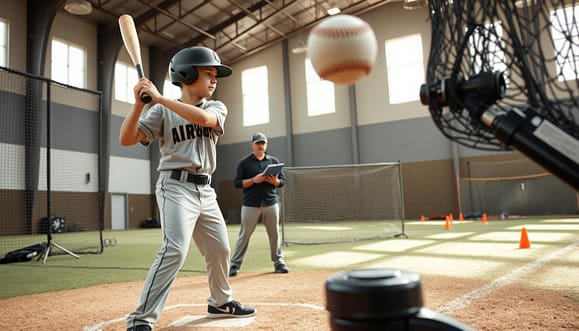
Machine work turns into your timing lab. A 59 mph pitch from 35 feet mimics a 95 mph fastball’s timing. This way, you practice game-speed decisions without needing a fast pitcher.
This method forces your brain and body to move at game speeds. The machine lets you focus on specific timing challenges.
Start with fastball recognition blocks. Use the machine for consistent velocity and location. Your task is to get on time with the pitch.
This builds the “move early” pattern. Your movements should start with seeing the pitch, not thinking about mechanics. The ball is the only cue that matters.
Once you’re good with fastball timing, we add chaos with off-speed adjustment. The machine throws different speeds, including changeups. This tests your ability to adjust quickly.
Your bat speed is useless if you commit too early. A hitter with 75 mph bat speed who commits too soon will hit weaker than one with 65 mph bat speed who adjusts better.
Research shows that focusing on mechanics can limit your motor system. Thinking about your swing against an 85 mph fastball means you’ve already missed the pitch.
| Training Method | Pitch Velocity | Reaction Time | Game Transfer | Primary Skill Developed |
|---|---|---|---|---|
| Traditional BP | 40-50 mph | 0.85-1.0 seconds | Low | Mechanical feel |
| Front Toss | 15-25 mph | 1.2+ seconds | Minimal | Bat path awareness |
| Machine Work (adjusted distance) | 59-75 mph at 35 feet | 0.42-0.48 seconds | High | Fastball recognition and timing pattern |
| Machine Work (velocity mix) | 45-75 mph randomized | Variable stress | Very High | Off-speed adjustment and visual discipline |
The training sequence is logical. First, practice against consistent velocity. Then, add speed variation. Lastly, introduce location changes to improve tracking and barrel accuracy.
Yes, you’ll have bad rounds. That’s okay. Failing at game speeds teaches more than succeeding at slow ones.
Your brain learns what’s “too early,” “too late,” and “just right” at game speeds. Comfortable practice leads to useless movement patterns.
The goal is functional mechanics for game chaos, not perfect swings at slow speeds. When your movements are reflexive to pitch speed and location, you’re ready for games.
This is where bat speed meets reality. Elite bat speed in open space means nothing without the right timing. Timing development turns raw ability into game-winning performance.
Stop practicing in a time zone that doesn’t exist in real baseball. Use machine work to simulate game-speed decisions. Develop timing patterns that work under real game stress.
The truth is, your kid’s swing problem is actually a timing issue. No amount of slow-motion practice will fix it.
Flighted BP ladder tee front toss machine velo mix approach reps
Most youth hitting programs throw kids into machine work like tossing someone into the deep end and calling it swim lessons. The flighted BP ladder fixes this by building skills in the right order, not the random order.
This is where progressive training transforms raw assessment data into game-ready hitting ability. You can’t build the third floor before laying a foundation, but you also can’t live in the basement forever and call it progress.
The ladder starts with tee work that isolates pure bat path without any timing variables. This is controlled environment training at its finest—no velocity guessing, no trajectory surprises, just you versus contact quality.
Next comes front toss, which introduces modest timing demands and trajectory variation. The ball arrives predictably, but now your brain must process movement and adjust slightly.
Then we graduate to machine work where velocity becomes the primary constraint and approach language gets tested under real pressure. This isn’t random batting practice—it’s intelligent sequencing with purpose.
Here’s what separates elite batting practice structure from glorified therapy sessions: every round has a scoring system, clear objectives, and consequences for failure. “Hit five line drives to the opposite field gap” is an approach rep worth tracking.
“Take some swings” is what you do when you’ve given up on measurable improvement. We don’t do that here.
The Hitting Plyo Ball®—those weighted balls that provide instant feedback—becomes your best friend in this system. Square contact gives you one sound and feel; poor contact gives you another. The body learns faster when feedback is immediate and honest.
Using approach language during machine rounds forces real adjustability. We program fastball-changeup sequences, high-low patterns, and in-out variations within the same round.
This builds a movement vocabulary that’s both stable and adaptable. Your core sequencing stays consistent—the “A swing” mechanics you’ve grooved—while your adjustability improves to handle different problems.
| Progression Stage | Primary Focus | Timing Demand | Success Metric |
|---|---|---|---|
| Tee Work | Bat path and contact points | Zero timing pressure | 90%+ quality contact |
| Front Toss | Trajectory recognition | Low timing pressure | 80%+ line drives |
| Machine – Single Velo | Speed-appropriate response | Moderate timing pressure | 75%+ green zone attacks |
| Machine – Velo Mix | Adjustability under pressure | High timing pressure | 70%+ quality with variation |
The velocity ladder component introduces speed progressively. Start at 60% game speed, master it, then advance to 70%, 80%, and game speed with variation mixed in.
Most programs fail because they either camp out in comfort zones too long or jump straight to game speed without building intermediate steps. Both approaches waste time and create bad habits.
We track three critical metrics during machine work: quality contact percentage, swing decisions (green zone attacks versus red zone chases), and adjustability within rounds. The data keeps us honest about actual progress versus feel-good nonsense.
Putting hitters in training environments that require specific skills often results in natural adjustments without verbal cueing. The body organizes itself when constraints are intelligent, and young athletes haven’t been over-coached into paralysis.
Here’s your approach rep menu for building complete hitters:
- Opposite field ladder: Five consecutive line drives to the opposite gap with increasing velocity
- Two-strike execution: Contact quality drill with focus on ball-in-play outcomes, no strikeouts allowed
- Fastball-changeup mix: Ten swings with 60-40 velocity split, score on swing decisions and contact quality
- High-low adjustability: Alternate pitch heights within same round, track barrel accuracy on both planes
- Zone discipline rounds: Mixed locations, score points for green zone attacks and losses for red zone chases
The batting practice structure you build today determines the hitter you’ll have next season. Random volume creates random results. Intelligent progression creates consistent improvement.
Every round needs a score, every session needs data, and every week needs measurable advancement through the ladder. That’s how you build hitters who don’t just look good in the cage—they produce when the lights come on.
Decision speed visual occlusion front flip with timing calls and two‑strike plan
Your athletes can swing fast, but if they can’t read spin and location quickly, it doesn’t matter. Bat speed is just numbers without brain power. Most youth hitting drills focus on mechanics, ignoring the brain’s role in success.
Elite hitters have just a split second to understand the ball’s spin and path. This isn’t just talk—it’s science.
The eyes and brain build visual confidence. This makes hitters move better based on what they see. Faster neural connections mean better decisions at the right time.
Visual Occlusion Work: Training Pattern Recognition Under Pressure
Visual training through occlusion is tough. We show hitters video clips of pitches cut off at different times. Then, they must decide on incomplete info.
This might seem harsh, but it’s what hitting is all about. Making decisions with partial data and trusting your instincts.
The pitch recognition gains from this training are real. Hitters learn to spot release cues and spin patterns sooner. This is training that makes sense mechanically and cognitively.
Front Flip with Timing Calls: Operationalizing Decision Training
This drill mixes theory with hard work. The coach flips the ball from a short distance but calls “now” randomly. Hitters must swing right away, without rhythm.
This drill is designed to be chaotic. It forces hitters to react without relying on timing or speed.
This decision training drill boosts reactive acceleration. It teaches hitters to trust their swing, not adjust it mid-swing. The randomness makes it more game-like than any machine work.
The Two-Strike Plan: Strategy Over Survival Mode
Most coaches tell hitters to shorten up with two strikes. This usually means swinging slower and hoping. Instead, we teach:
- Maintain bat speed—don’t sacrifice force for false control
- Expand zone awareness slightly—protect a bit more plate coverage
- Prioritize bat-to-ball over lift—line drives beat pop-ups with two strikes
- Keep aggressive intent—confidence drives better sequencing than fear
This is a plan. “Just put it in play” is a prayer, not a strategy. Athletes feel the difference.
Research shows athletes who focus on the ball perform better. So, these youth hitting drills overload the senses while keeping swing advice simple.
Tracking What Actually Matters
Batting average is not the best indicator. We track leading indicators you can train:
- Quality contact percentage—hard-hit rate above exit velocity thresholds
- Swing decisions—did you swing at pitches you should have?
- Competitive at-bat outcomes—quality of process, not just results
- Visual recognition speed—measured through occlusion drill accuracy
We’re building hitters who see and decide faster. This is real confidence at the plate, seen in metrics before box scores.
The gap between elite and average hitters isn’t just about bat speed. It’s about recognizing patterns early and acting confidently. Bat speed is just the start. Pitch recognition is what makes it precise.
Bat speed development overload underload med ball scoop slams intent days
If there’s one number that makes parents check their wallets and coaches promise the moon, it’s bat speed. It’s true—you can’t hit the ball hard if the bat’s slow. But raw speed without direction is just violence without meaning.
The real question isn’t whether bat speed matters. It’s whether you’re training it correctly.
Most facilities tell kids to swing harder. That’s not a protocol—it’s hope disguised as instruction. Our hitting lab uses overload training and underload training because the science is too strong to ignore.
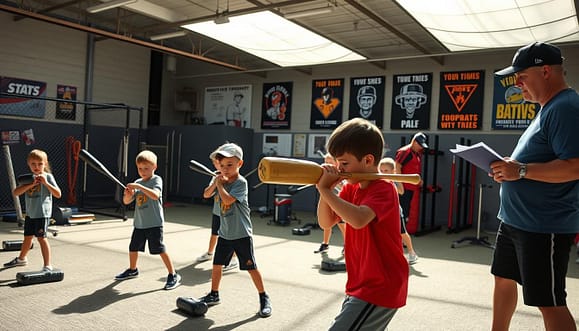
Here’s how it works: you swing a heavy implement, and your body fights through resistance. Then, you swing a light implement, and that same drive makes you move faster. The contrast between heavy and light is where you adapt.
This isn’t just bro-science. It’s post-activation potentiation, backed by decades of strength research.
The Heavy-Light-Game Progression
Our protocol follows the HLG sequence: Heavy, Light, Game bat. Each phase has a specific purpose, and skipping steps defeats the whole system.
| Bat Type | Weight Range | Rep Count | Primary Focus |
|---|---|---|---|
| Overload (Heavy) | 30-35 oz | 5 swings | Full-body sequencing, posture maintenance, coil-uncoil mechanics |
| Underload (Light) | 18-22 oz | 5 swings | Maximum speed while preserving same positions and mechanics |
| Game Bat | Player’s standard | 5 swings | Integration of power from overload with speed from underload |
The overload bat teaches your body to keep posture under load. No head roll. No lumbar hyperextension. You’re building strength through the right movement pattern, not bad habits.
The underload bat lets quickness show up naturally. You’re not thinking about positions anymore—you’re hunting maximum velocity. This is where constraint-based learning kicks in: the environment demands speed, and your nervous system figures out how to deliver it.
The game bat integration round is where you measure progress. Track exit velocity across weeks on these five swings. That number climbing? You’re adapting. That number flat? Something in the protocol needs adjustment.
Med Ball Scoop Slams for Attack Angle
Now let’s talk about med ball scoop slams. These aren’t just “core work” thrown into the program. They’re pattern imprinting for launch efficiency.
The scoop slam trains the exact sequencing you want at contact: loading into the back hip, explosive hip hinge, accelerating from low to high through an upward path. That low-to-high acceleration? That’s your attack angle being programmed into your movement library.
Think of it as rehearsal for the swing path you need when the ball’s in the zone. You’re not just throwing a ball—you’re training your body to generate force along the same vector you’ll use to elevate baseballs.
Three sets of eight reps, full intent on every single throw. If you’re not grunting, you’re not doing it right.
Intent Days: Permission to Be Dangerous
Then we have intent development days, which sound simple but represent a massive philosophical shift for most youth players. These are sessions where the only objective is maximum effort.
No mechanical thoughts. No positions. No pretty swings. Just “how fast can you move this bat and how hard can you hit this ball?”
These sessions accomplish two critical things. First, they establish your true speed ceiling, which is usually higher than you think. Second, they teach you what maximum effort actually feels like, because most youth players have never swung with full intent in their lives.
They’ve been coached into cautious, controlled, mechanical swings that prioritize looking correct over being dangerous. They’ve learned to swing carefully, not violently. Intent days give them permission to unleash, and speed follows violence when direction is already established.
Here’s the protocol for intent days:
- Five-minute dynamic warm-up focused on explosive movements
- Three rounds of overload-underload contrast (no game bat)
- Ten full-intent swings into a net or off a tee, tracked for peak bat speed
- No feedback on mechanics—only celebration of maximum effort
- Recovery day required after intent sessions
You run intent days once per week during the development phase, twice per week during off-season when volume allows. Track peak bat speed from these sessions separately from your game bat integration work. These numbers represent your ceiling—what you’re capable of when constraints are removed and violence is encouraged.
The gap between your intent-day peak and your game-bat average tells you how much speed you’re leaving on the table during actual hitting. Close that gap, and you’re not just getting faster—you’re learning to access your speed when it matters.
That’s the whole point of this protocol. Speed is useless if you can’t deploy it consistently, and consistency comes from training the nervous system to operate at high output without conscious thought. Overload training builds the engine. Underload training reveals the speed. Intent days teach you to access it on demand.
And when a 12-year-old realizes they can swing five mph faster than they thought possible? That’s not just physical development. That’s identity shift. They stop seeing themselves as someone who needs to be careful and start seeing themselves as someone who can be dangerous.
That mindset change is worth more than any drill.
Contact quality barrel accuracy tee grids opposite field and adjustability ladders
Contact quality turns raw power into effective hitting. Most youth programs miss this point. They focus on bat speed but forget about precision.
Without precision, even the fastest swings can be weak. The key difference between a good hitter in practice and a great one in games is contact management.
This is where we refine the weapon. Speed becomes precise. Intent meets execution.
The Tee Grid System
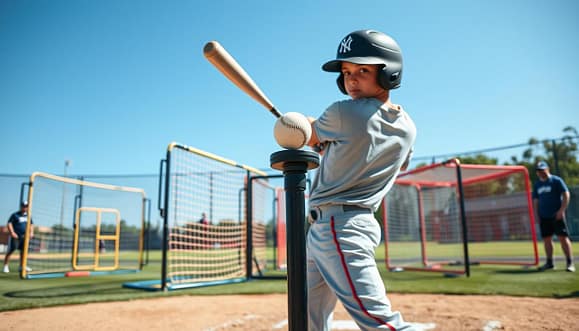
Tee grids are not old-school. They offer a variety of contact points. Hitters must adjust their swing to each spot while staying aggressive.
This method is different from usual youth drills. We focus on adaptability by changing the swing pattern.
Trying to hit a high-away pitch with a low-inside swing won’t work. The ball doesn’t like stubborn swings. Each spot on the tee grid needs a specific swing angle, helping hitters adjust without live pitching pressure.
Opposite Field Work as Truth Detector
The opposite field is key for hitters. It shows if they can hit the ball with power to the other side. If they can’t, something’s off.
Line drives to the opposite field show a hitter can stay back and hit the ball well. It’s honest feedback that can’t be faked.
This isn’t just about hitting to the opposite field. It’s about showing you can do it when needed. That’s true barrel control.
Adjustability Ladders and Progressive Sequences
The adjustability ladder adds a bit of chaos to each round. We start with middle pitches, then move to different locations and heights. This keeps hitters on their toes.
Most programs keep things too stable. They repeat the same pitches and locations too much. Then, they wonder why it doesn’t work in games.
Adaptability is a skill we can teach. We do this by making drills more like game situations but without the stress.
Weighted Balls for Instant Feedback
Weighted balls give honest feedback. A square hit sounds one way, while a miss sounds different. They tell the truth quickly.
This feedback is immediate. Hitters learn to feel the difference between a good hit and a miss. This learning sticks better than just listening to coaches.
Tracking Contact Quality Metrics
We track how often hitters make quality contact. We see if they can hit pitches in all areas or just the middle.
The data shows us where hitters need to improve. Here’s what we look at in contact quality sessions:
| Metric | Target Standard | Assessment Method | What It Reveals |
|---|---|---|---|
| Quality Contact % | 70% or higher | Square contact on weighted balls or exit velo threshold | Overall barrel precision and consistency |
| Opposite Field Line Drives | 3 out of 5 attempts | Launch angle between 10-25 degrees to opposite field | Timing discipline and barrel path connection |
| Zone Coverage | 65% across all quadrants | Tee grid success rate by location | Attack angle adjustability and approach versatility |
| Adjustability Response | Maintain 65% quality through sequence changes | Ladder drill contact quality during mixed locations | Real-time adjustment capacity under variability |
The Natural Movement Philosophy
We let hitters be themselves and compete naturally. Most find their best swing when they’re not forced to swing a certain way.
Most coaching should focus on helping hitters drop unnatural swings. Rigid swings lead to rigid results. Flexible athletes make better contact.
Barrel accuracy is about hitting well in games, not being perfect. These drills help hitters achieve that.
Compete mode game‑like constraints scoreboard rounds and KPI chart
Training without competition is like practicing a speech alone and hoping it works in front of people. It looks good in the mirror and feels right when no one is watching. But when the lights go on and the audience appears, your skills disappear.
That’s why we add compete mode to every training session. It’s not just extra practice or something we add when athletes are ready. It’s the core where everything is tested or shown to be fake.
Game simulation works because it adds the real-world challenges that show the truth. It forces athletes to make quick decisions and face the consequences of their actions. This is where pressure training shows if skills are real or just for show.
We make training competitive by adding real-world challenges. “You have five swings to get three quality line drives” is a challenge. “Just take some swings” is not. The difference shows if skills work in real games or just in practice.
Scoreboard rounds make athletes accountable, something many youth programs ignore. Round one shows your starting point—maybe you hit 60% of your swings well. Round two asks if you can beat yourself while others watch. It’s not about being perfect. It’s about beating your own performance under pressure.
The way athletes talk about their game changes in compete mode. We focus on strategy, not just mechanics. What’s the plan? Are we looking for specific pitches or taking what we get? How does two-strike thinking differ from being aggressive?
This thinking separates good hitters from those with talent. One group relies on physical skill and hopes it shows up. The other group makes decisions based on a plan, no matter how they feel.
The KPI chart tracks what really matters for success, not just numbers that can be skewed by luck. We focus on performance metrics that athletes control:
- Quality contact percentage across all swings taken
- Swing decision accuracy—did you attack green zone pitches and manage or take everything else?
- Hard-hit rate independent of whether balls found grass or gloves
- Competitive at-bat outcomes measured against specific objectives
- Barrel accuracy under time pressure and pitch variety
We track these weekly. Athletes see their progress, not just if their team won or their batting average looks good. The numbers show real skill development that box scores can’t capture.
Most programs miss the psychological advantage of training under pressure. Skills built in calm, controlled environments don’t work when it’s real. You’re hoping your practice swings magically work in games.
But when you train under real competition where failure is clear and ego is at risk, you build skills that are pressure-indexed from birth. They’re ready for pressure, not just hoping to handle it later. Pressure is where they were built and honed.
Our scoreboard rounds get harder while keeping success clear. They follow a simple structure:
| Round Type | Constraint | Success Metric | Pressure Element |
|---|---|---|---|
| Foundation | 8 swings, quality contact focus | 70% line drives or better | Visible scoring, peer comparison |
| Decision | 10 pitches, swing/take calls | 85% correct decisions | Immediate feedback, limited margin |
| Execution | 6 swings, specific outcomes | 4 of 6 meet objective | Reduced attempts, higher stakes |
| Elite | 5 swings, match previous best | Beat personal record | Self-competition, performance history |
The magic happens when athletes realize their skills are repeatable under stress. That’s when competitive training becomes real performance development. That’s when practice and games meet for good.
At home program 15‑minute routines and parent do and don’t list
The real test of any hitting program isn’t just what happens in the facility. It’s what happens in a suburban backyard with a parent using YouTube advice. Most programs create something great in the lab but fail when kids go home.
At home, families need routines that are quick, don’t need much equipment, and are hard to mess up. We focus on decision-making and games with rules, not just repeating movements. The last thing young hitters need is Dad trying to teach mechanics he doesn’t understand.
Each routine is fifteen minutes or less. This is because kids have short attention spans and parents have limited time. Practice efficiency is better than long sessions that happen rarely.
Routine One: Shadow Recognition Work takes five minutes and needs only a phone. Watch pitch video clips and pause at key points. The hitter calls the pitch, identifying it without swinging. This builds pattern recognition without any risk of technical damage.
The See-Decide-Swing progression is routine two. It’s ten minutes long. Five reps tracking pitches without swinging, five swinging at quality strikes, and five full-intent swings. Use whatever equipment you have.
Routine three introduces the Green-Yellow-Red zone game. Balls are flipped to different locations. The hitter calls out the zone color before swinging. This game reinforces strike-zone discipline without needing technical coaching.
The parent coaching guidelines are key. Most damage comes from bad advice on swing mechanics. These routines are designed to work even if parents don’t know about biomechanics. They focus on decisions and effort, not mechanics.
| Parent DO List | Parent DON’T List | Why It Matters |
|---|---|---|
| Focus on decision quality and effort level during each rep | Give mechanical advice about swing plane, hand path, or body positions | Decision-making is coachable without technical expertise; mechanics require trained eyes |
| Track simple metrics like quality contact out of ten swings | Diagnose swing problems from result outcomes | Metrics create accountability; diagnosing creates confusion and conflicting information |
| Make practice competitive, fun, and game-like with constraints | Turn sessions into tension-filled mechanical surgery that kills enjoyment | Engagement drives consistency; tension drives kids away from the sport |
| Reinforce attack mentality and aggressive swings in the zone | Over-coach plate discipline until the hitter becomes passive and defensive | Youth development needs controlled aggression, not mechanical caution |
The table above shows what often happens in American backyards. Parents turn youth hitting drills into mechanical lessons because they think more advice is better. It’s not. It leads to analysis paralysis and hitters who can’t react.
This approach keeps skill maintenance going between sessions without confusion. Kids stay engaged, and parents help without causing harm. The gap between training days becomes productive, not damaging.
The fifteen-minute structure is realistic. Families are busy, and kids have a lot going on. A sustainable at-home training routine is better than a big program that never happens. Three fifteen-minute sessions a week are more beneficial than one long session everyone resents.
Equipment needs are minimal. A bucket of balls, a tee, and maybe a net if you have one. You already own the phone for video work. These routines work anywhere, for any family.
The focus on constraints keeps parent coaching effective. Drills with built-in rules make feedback objective. “You swung at a red zone pitch” is helpful. “You dropped your back shoulder” is just opinion.
Most importantly, these routines keep kids connected to the training system between sessions. The skill maintenance they provide prevents regression. Young athletes forget quickly. These quick sessions prevent decay and avoid over-training.
Progress report template for coaches
Your hitting lab curriculum thrives on what you measure and share. Parents and players invest a lot. You must show them clear progress, not just vague improvements.
Organize every progress report into five parts. Begin with Baseline Metrics: bat speed, exit velocity, and attack angle at the start. Then, list Skill Development Progress: quality contact, swing accuracy, and adjustability scores over time. Next, include Competitive Performance Indicators: quality contact, pitch selection, and competitive at-bat results.
Highlight Areas of Focus with two or three specific goals. Use outcome language, like “Expand coverage to away zone while maintaining bat speed on off-speed recognition.” This is better than vague goals like “work on outside pitches.” Finish with Recommended Next Steps: facility work, home routines, and mental focus areas.
Improving players is tough. It takes just five minutes to film swings and spot issues. The real challenge is helping athletes make lasting improvements without messing up what works. Your coaching assessment shows if you’re up to this task.
Performance reports with exit velocity trends, swing decision charts, and video comparisons tell a clear story. Saying “Quality-contact rate improved from 40% to 65%” shows real progress. But “Needs to work on swing” doesn’t. Data beats opinions, and real progress tracking sets true programs apart from those based on feelings.