

Maximizing rental space isn’t just about size. It’s about knowing how to use the space well. I’ve seen coaches turn small areas into top-notch training spots. Others, despite having more space, make it a mess.
DFW Indoor Sports makes top-notch equipment affordable. You get consistent weather, professional pitching lanes, and can play many sports. It’s perfect for young athletes at all levels.
But, the facility’s value depends on your coaching plan. Before booking, you need a solid strategy for indoor baseball coaching. This ensures you get the most out of your time and money. In youth sports, every minute counts.
And unlike participation trophies, real success matters.
Booking system peak vs off‑peak pricing multi‑team blocks and insurance requirements
Booking cages at DFW Indoor Sports is simple: pay smart, not often. Knowing how to price helps coaches save money, not just spend it.
The basic baseball lane rental costs $45 an hour. You get baseballs, cones, markers, tees, and setup. No extra fees or surprises.
The top tier is $85 an hour, adding video analysis. Every swing and stance is tracked. It’s a must-have in 2025.
Off-peak scheduling is where you save. Tuesday afternoons are cheap and quiet. You get the same facilities without the crowd.
Peak hours are weekday evenings and weekend mornings. Everyone wants these times, making them expensive. Off-peak hours are cheaper and quicker.
Booking with other teams lowers costs. It’s like buying in bulk. You save money by sharing the space.
The online booking system confirms your spot instantly. No phone calls or waiting. It’s easy and fast.
| Package Type | Hourly Rate | Included Equipment | Best For |
|---|---|---|---|
| Basic | $45 | Balls, cones, tees, markers, setup | Fundamental drills and volume reps |
| Premium | $85 | Basic plus video analysis and tracking | Technical refinement and data collection |
| Off-Peak Basic | Contact for rates | Same as Basic package | Budget-conscious programs |
| Team Block | Discounted rates | Customizable based on needs | Seasonal programs and regular bookings |
Team rentals get discounts for regular use. The facility rewards teams that book often. It helps everyone plan better.
Equipment storage saves time before practice. Your gear is ready. You can focus on coaching.
Insurance is a big deal. Most places need $1-2 million aggregate coverage. Make sure your policy matches.
Don’t assume you’re covered. Confirm your insurance details. It’s better to be safe than sorry.
The booking system lets you book in one-hour blocks. It’s flexible for busy schedules. You can plan around school and tournaments.
Having multiple lanes means full practices. No waiting or idle time. It’s like how corporate events use space well.
Calculate your cost per athlete hour. Include drive time and setup. The $85 package might be worth it for the edge it gives you.
The booking system remembers your preferences. Set it once and save time. You can focus on coaching.
Smart team rentals use off-peak rates and discounts. They save time and money. It’s about getting the most out of every dollar and minute.
Practice menus 60‑90‑120 minute templates for hitting defense and baserunning
Practice templates are key to effective training, not just expensive babysitting. You’ve rented the space and gathered the athletes. Now, you face sixty to one-hundred-twenty minutes wondering if your plan will work.
Here’s the truth about baseball practice planning: being disorganized costs more than just rental fees. It costs you valuable repetitions, attention, and the trust of your athletes. Plan your session before you start, or you’ll waste time untangling nets.
The 60-minute sprint format is great for focusing on one skill. Start with fifteen minutes of warm-up and arm care. Then, spend thirty minutes on station work like hitting or defense.
The last fifteen minutes are for competitive games. This lets athletes practice under pressure. This format cuts out unnecessary activities and focuses on quality training.
The 90-minute balanced session is a staple. It includes a warm-up, then three twenty-minute stations. This lets you cover hitting, defense, and baserunning evenly. Remember to include five-minute breaks for athlete recovery.
Rotating stations keeps athletes engaged. One group does tee drills, another practices baserunning. This keeps the energy high and prevents boredom.
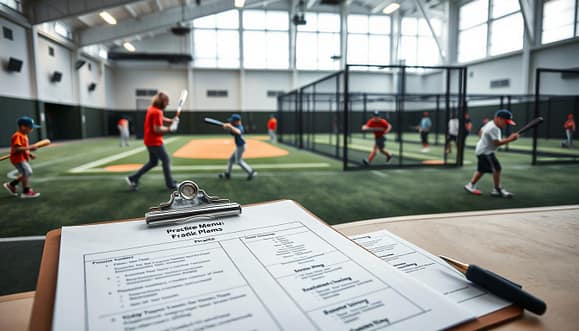
The 120-minute practice is where DFW Indoor Sports shines. You can run multiple stations at once. This creates a mini-camp environment where athletes can work on different skills.
This format needs more planning but offers more training. At DFW Indoor Sports, everything is ready to go. You can start coaching right away, without wasting time on setup.
| Session Length | Warm-Up Duration | Primary Work Blocks | Best Use Case |
|---|---|---|---|
| 60 Minutes | 15 minutes | 30-min focused skill + 15-min competition | Single-skill intensive sessions |
| 90 Minutes | 15 minutes | Three 20-min rotating stations | Balanced multi-skill development |
| 120 Minutes | 15 minutes | Multiple simultaneous 25-min stations | Team-wide training |
Customized programs through DFW Indoor Sports coaching staff fit into your templates. They handle technical skills while you manage the plan. This way, you can focus on coaching while they handle the details.
Keep your templates, time your transitions, and adjust based on results. What works on paper might not work in practice. That’s okay—just keep refining your plans.
The facilities offer professional setup with every rental. This means you can start practicing right away. No need to waste time setting up equipment.
Using templates well is what separates good coaches from great ones. You have the space, the athletes, and the plan. Now, it’s time to execute and see results.
Small‑space games live reads cage baseball reaction ladders and machine safety
Most coaches see limited space as a problem. But smart ones see it as a chance to innovate. Small-space training makes athletes sharper because they can’t hide behind distance.
Training in tight spaces makes athletes make quick decisions. They can’t hesitate because the ball comes fast. This makes them react faster and learn from mistakes quickly.
DFW Indoor Sports creates pitching lanes for this fast-paced training. It helps all players, from beginners to pros. Every drill counts because there’s no room for error.
Cage baseball turns baseball drills into fun games. It uses screens and soft-toss stations for instant feedback. This makes training feel like a game.
Here are some small-space training games that keep players engaged:
- First-to-Ten Quality Swings: Athletes compete for clean contact, not just volume
- Situational Hitting Challenges: Two-strike approaches, hit-and-run execution, specific zone targeting
- Defensive Reaction Games: Coach fires balls from eight feet away; fielders read, react, secure
- Live-Read Progressions: Start with soft toss, advance to machine feeds, finish with coach throws
- Time-Pressure Drills: Complete specific tasks within countdown windows
Failing in these drills is quick and cheap. If you miss a read, you learn right away. But, missing in a big game can cost a lot.
Reaction training helps athletes make quick decisions. It’s not just for looks. It’s for real-life situations, like facing a 75-mph fastball.
But, let’s talk about something important: machine safety isn’t optional. Pitching machines are great for training but can also be dangerous. Following safety rules is key.
Before starting, athletes must show they know how to use the equipment. DFW Indoor Sports provides everything you need. Your job is to use it right.
Here’s what you must do for baseball drills with machines:
- Helmets secured properly (not perched like fashion accessories)
- Distance markers respected (manufacturer specifications exist for legal reasons)
- Zero-penalty stop culture (calling “stop” carries no social cost)
- Proper stance verification before feeds activate
- Clear communication protocols between machine operator and athletes
Coaches sometimes rush because they’re on a tight schedule. But, this can lead to accidents. The staff at DFW Indoor Sports is here to help avoid that.
The equipment works for all skill levels. This means everyone must follow safety rules. Beginners and pros need to be careful.
The right mix of reaction training and safety equals great training without injuries. This isn’t being cautious; it’s being professional.
Using pitching lanes and cages well can speed up training. It makes athletes think and react faster. They can’t hide bad technique in a small space.
Smart coaches use these challenges to their advantage. The facility gives you the tools; you bring the creativity. Just make sure everyone leaves with their teeth intact.
Team testing combine ideas exit velo pop time run splits and throwing program set‑up
Performance metrics turn vague ideas into clear actions. They help you focus on what really matters. This way, coaches can build real programs, not just hope.
Exit velocity is a big deal in baseball, thanks to Statcast. It shows how powerful a player is. DFW Indoor Sports offers $85/hour premium packages with video analysis technology to help with this.
Set up your radar gun station right. Use the same method every time. This way, you can see real trends in a player’s power.

Measuring pop time for catchers is simple. You just need a stopwatch and a steady distance to second base. This shows how fast they can throw.
The 60-yard dash is a key test for speed. But 30-yard splits are more important for real game speed. They show how fast a player can move.
Tracking performance over time is key. One data point is just trivia. But six points tell a story of real improvement.
Throwing programs are important but often overlooked. Start with long-toss at 30 feet and increase it as needed. DFW Indoor Sports offers customized training programs for competitive teams that focus on proper throwing.
Arm care is essential before and after every session. Use resistance bands and light weights to prevent injuries. Video analysis helps athletes improve between sessions.
The facility’s baseball performance tracking and analytics for skill development help keep records for years. No more lost data or forgotten progress.
Test players at the start, middle, and end of the season. Share results privately to avoid competition. This helps players focus on improving, not just winning.
Use data to tailor training plans. Every player is different. A catcher needs different work than an outfielder. The data shows what each player needs.
Advanced equipment in team rentals helps teams practice better. This controlled environment helps players improve all year, not just in good weather.
| Testing Component | Equipment Required | Frequency Recommendation | Data Application |
|---|---|---|---|
| Exit Velocity | Radar gun, tee, video system | Bi-monthly during season | Power production trends, swing adjustments |
| Pop Time | Stopwatch, regulation bases | Weekly for catchers | Transfer efficiency, arm strength gains |
| 60-Yard Dash | Stopwatch, measured distance | Start, mid, end of season | Speed baseline, conditioning effectiveness |
| Throwing Velocity | Radar gun, proper throwing lanes | Monthly across positions | Arm strength development, injury prevention |
Structured testing in baseball is all about improvement. It lets coaches tailor training and see real progress. This builds confidence in the program’s effectiveness.
Coaches corner storage staging warm‑up stations and traffic flow
No one tells you how much facility layout affects player growth. The area for drills and bag storage can make or break a practice. Many coaches focus on drills but forget about the space needed for them to work.
Your coaches corner is key to a smooth practice. DFW Indoor Sports offers storage for team equipment, making setup easier. This way, athletes know where to find and return their gear.
Setting up staging areas is a game-changer. It keeps practices running smoothly and saves time.
Staging areas are more important than you think. Have a routine where stations are ready before athletes arrive. This cuts down on waiting time and keeps everyone focused.

Warm-up stations should be set up in a way that athletes move naturally. This leads to better arm care and position-specific training. It also makes the most of the available space.
Good traffic flow is all about solving spatial problems. Find out where the bottlenecks are and plan routes to avoid them. Use specific lanes for different activities to keep everyone safe and on track.
The setup at DFW Indoor Sports allows for efficient use of space. You can have hitting, defense, and baserunning happening at the same time. But, you need to plan it out first.
Bad spatial planning can ruin a practice. It leads to wasted time and money. Take the time to map out your space before your first practice.
With good planning, your practices will run smoothly. Practice organization is key to success, not just for the players but for the coaches too.
The setup at DFW Indoor Sports is top-notch. But, it’s up to you to use it wisely. A good layout can make all the difference in developing your team.
Equipment should be in its place, and athletes should know where to go. Stations should work together without any hiccups. These are the basics of a well-run practice.
Fundraising tournaments camps and birthday clinics with DFW partnership
Your booster club might not have found oil, but you need fundraising events that work. DFW Indoor Sports turns team rentals into a way to fund your season without asking parents too much.
This partnership creates three ways to make money. Each method has its own way of making money, but they all have one thing in common: predictable margin if you plan well.
Hosting tournaments is simple math. Rent the place for eight hours, sell spots to eight teams at $200 each, and you make $1,600. After costs, you have $900-1,100 for your team.
Do this four times a year, and you can cover travel costs without asking for more car washes. The facility can handle different group sizes, so you can control how many people come.
Baseball camps need more work but can charge more. You’re selling lessons and experiences, not just access. Good coaching and programs justify the $150-300 per camper price.
Here’s how the revenue models compare:
| Event Type | Revenue Per Event | Operational Complexity | Profit Margin |
|---|---|---|---|
| Tournaments | $1,600 (8 teams) | Low to Medium | $900-1,100 |
| Baseball Camps | $3,000-6,000 (20 campers) | Medium to High | $1,500-3,500 |
| Birthday Clinics | $400-600 per party | Low | $200-350 |
Birthday clinics are a mix of sports and fun. Partner with DFW Indoor Sports for packages that include games, challenges, and facility access. You get extra money and visibility in the community.
The special events options are flexible. DFW Indoor Sports offers packages for all kinds of events, from small parties to big showcases. You can brand these as fundraisers for your program.
Call their event coordination at (817) 938-0808 to talk about custom prices. They offer discounts for big orders, but you have to ask.
Get everything ready before your first event. You need systems for registration, waivers, emergency plans, and refunds. These are legal and operational must-haves.
One bad event can hurt your fundraising. Events done well create ongoing income. Events done poorly cause problems and legal risks.
Choose events based on what your staff can handle well. A well-run tournament is better than a camp that fails due to poor planning. Start with what you can do well and grow from there.
Safety checklist netting L screens helmets footwear and lightning shelter plan
Safety checklists are important but nobody likes to talk about them. They’re like the necessary evil of professional sports. They help coaches avoid big mistakes and keep athletes safe.
Facility safety standards at DFW Indoor Sports set the minimum. But coaches have to make sure everything is safe during practice.
When you book a cage, you promise to keep athletes safe. This is a big responsibility that courts take seriously.
Pre-Practice Equipment Inspection Protocol
First, check the netting every time. Look for tears and make sure it’s tight. A bad net can lead to big problems.
Checking equipment carefully is important. It helps prevent injuries and keeps everyone safe.
L-screens are key for safety. Place them 48-52 feet from home plate. They protect players from fast-moving balls.
Physics doesn’t care about reflexes when a ball is coming fast. Always use the L-screen.
| Equipment Type | Inspection Frequency | Critical Check Points | Replacement Indicators |
|---|---|---|---|
| Batting Helmets | Before each use | NOCSAE certification, crack inspection, fit verification, padding integrity | Visible cracks, expired certification (5-10 years), loose padding, impact damage |
| Protective Netting | Every session start | Tear inspection, tension check, anchor security, mesh integrity | Any tears, loose mounting points, significant sagging, UV deterioration |
| L-Screens | Weekly detailed check | Frame stability, net attachment, base weight, positioning marks | Bent frame, torn netting, unstable base, rust on connection points |
| Training Equipment | Monthly audit | Moving parts, electrical connections, emergency stops, wear indicators | Manufacturer recommendations, excessive wear, malfunction history, safety recalls |
Helmet Standards and Footwear Requirements
Helmets need regular checks. Look for cracks and make sure they’re certified. Yes, helmets expire, usually in 5-10 years.
DFW Indoor Sports provides helmets and gloves. But coaches must check if they fit right. The helmet should fit snug but not too tight.
Protecting athletes is a must. Don’t let anyone say they don’t like helmets. They need to know why helmets are important.
Wearing the right shoes is also key. Turf shoes or sneakers with good grip prevent injuries. No sandals or casual shoes allowed.
Proper footwear is a must for everyone. It helps prevent injuries from fast-moving balls or throws.
Climate Control and Emergency Protocols
Having a plan for lightning is important. DFW Indoor Sports keeps athletes safe from bad weather. But, they need a plan for when they leave the facility.
Make sure you have a safe place for parents to pick up their kids. Have a plan for when the weather gets bad.
Decide when it’s too dangerous to practice. Don’t let parents decide. You’re the coach, make the call.
Documentation and Liability Management
Write down your safety protocols. Train your staff to follow them. Tell parents and athletes about them before practice starts.
Spending time on safety talks is worth it. It helps prevent injuries and keeps everyone safe. Keep records of everything.
Make sure your safety standards are high. Ask for proof of DFW’s safety measures. This helps you know what you need to do better.
Coaching means taking care of athletes. It’s not just about winning. It’s about keeping everyone safe.
Good safety management means nothing bad happens. But, it’s better to prevent problems than explain them in court.
Prevention is always better than explanation. It keeps athletes safe and coaches out of trouble.
Sample season plan alternating skill days and in‑season recovery
Intentional development beats chaos with a season planning framework. Most coaches rent space and wing it, hoping repetition leads to improvement.
But it’s not that simple. Real development needs structure, progression, and recovery in your skill development schedule from the start.
The alternating skill-day framework helps create development arcs in your season. Smart coaches use practice templates in a four-week rotation:
- Week One: Hitting mechanics—load, stride, swing path, the unsexy fundamentals that actually determine success at the plate
- Week Two: Defensive reads and positioning—footwork, glove work, throwing mechanics from various positions
- Week Three: Baserunning and situational awareness—leads, jumps, reading pitchers, aggressive decision-making
- Week Four: Integrated game scenarios—combining all three skill sets through simulated competition
Repeat and adjust based on weaknesses. The predictability is key—athletes know what’s coming, parents understand, and progress is tracked.
In-season recovery is key for experienced coaches. Too many confuse activity with productivity, leading to overuse injuries. Development needs stress plus recovery.
Stress without recovery leads to breakdown. Your season planning should include recovery protocols:
- One practice weekly focused on mental reps and video review
- Active recovery sessions for mobility and arm care
- Frank conversations about fatigue management
Modern youth athletics has lost its mind on specialization and volume. Smart coaches use evidence-based recovery strategies.
DFW Indoor Sports offers flexible scheduling. Adjust frequency and intensity based on need, not arbitrary commitments.
Pre-season might have three sessions building work capacity. Peak season might need two for maintenance and game prep. Post-season might require one for skill correction and next-season foundation.
The training periodization principle is key for serious athletic development. Organize training in phases with distinct objectives, progressive loading, and recovery in every cycle.
| Season Phase | Weekly Frequency | Primary Focus | Intensity Level |
|---|---|---|---|
| Pre-Season | 3 sessions | Building work capacity and foundational skills | High volume, moderate intensity |
| Peak Season | 2 sessions | Maintenance and game-specific preparation | Moderate volume, high intensity |
| Post-Season | 1 session | Skill correction and next-season foundation | Low volume, focused quality |
This training periodization approach maximizes adaptation and minimizes burnout. Over time, it creates advantages that separate good programs from mediocre ones.
Document your plan clearly. Share it with parents to explain the method behind the schedule. This way, they won’t panic when intensity is dialed back during peak season.
Adjust based on athlete feedback. The plan should serve the athletes, not the other way around. Include your practice templates in the documentation for consistent execution by assistants.
Smart planning maximizes adaptation and minimizes burnout. The skill development schedule becomes a roadmap everyone understands, not a mystery tour.
Or you could wing it every week and wonder why results plateau after the first two months. Your choice, coach.
Contact sheet rental policies and team discount codes
Administrative details might not be exciting, but they’re key to success. Call Program DFW Indoor Sports at (817) 938-0808 and save it in your phone. Share it with your assistant coaches too. Having that number handy is essential, just when you need it most.
The online reservation system gives you instant confirmation. This is important for any scheduling issues that might come up. Team rentals are available in one-hour blocks, with a minimum of one hour. Make sure you know the cancellation policy, usually 24-48 hours for refunds.
Teams that book regularly can get discounts. Look into seasonal packages and multi-week deals. Peak times, like weekday evenings and weekend mornings, fill up fast. These times are popular, so book early.
Keep a shared document for all booking details. It should track confirmation numbers, practice dates, payments, and discounts. This might seem boring, but it helps avoid confusion later. Doing the admin work well saves you time and stress in the long run. It’s not glamorous, but it’s necessary.