
Most select baseball Houston groups are just weekend activities with matching jerseys. I’ve seen too many “select” teams to believe the hype. It’s often just a fancy way of saying they have a good credit card.
But then, you find a group that’s truly dedicated. They’re based in Tomball and have a structure that would impress any German engineer. They’re a 501(c)(3) non-profit, showing they’re not in it for the money.
Their goal is to use sports to improve lives. It sounds like corporate speak, but they actually have the means to do it. They have professional coaches who teach more than just how to swing a bat. They teach the science behind it, mixing sports with child psychology.
Their “Built. Not Bought” motto is more than just words. It shows in their academy training and how they care for players’ arms. This place focuses on training, not just winning games.
The big difference is clear. One builds athletes, the other just wins trophies and boosts parents’ pride.
Year‑round plan off‑season skill blocks pre‑season ramp in‑season maintenance
Most youth baseball programs ignore periodization. Texas Brigade does it differently. They plan their year-round training like a documentary, not a highlight reel.
The development plan has three phases. Each has its own goals and training focus. This way, there’s no last-minute chaos.
Off-season training happens from November to January. It’s like a lab where players try new things. They work on their swing and footwork without the stress of games.
February to March is the pre-season. It’s when players start to put their skills together in game-like situations. The intensity goes up, and they face real pitching.
| Training Phase | Timeline | Primary Focus | Practice Intensity |
|---|---|---|---|
| Off-Season | November – January | Skill acquisition and mechanical refinement | Moderate volume, low competitive stress |
| Pre-Season | February – March | Skill integration and game preparation | Increasing volume and intensity |
| In-Season | April – October | Performance maintenance and recovery | Consistent frequency, managed workload |
April to October is the in-season. Now, it’s about keeping the skills sharp. They focus on recovery and learning new tactics.
Brigade’s plan is different from the tournament-of-the-month model. They use structured practices and think long-term. Each phase builds on the last, making development sustainable.
They add strength and agility training in all phases. This is based on the player’s age and needs. They use data to guide their coaching, not just guesses.
Brigade sees youth baseball as real athletic development, not just weekend fun. They have a set schedule for year-round training. This way, players can grow without burnout.
Key parts of their plan include:
- Multiple team practices per week to keep skills sharp
- Arm care programs in every cycle to avoid injuries
- Performance metrics to track progress fairly
- Recovery protocols to keep players ready
- Phase-specific objectives for long-term growth
It’s not about being complex. Simple, consistent plans work better than complicated ones. Brigade sticks to their plan and sees development as a long-term investment.
Team structure age groups rosters competition level and tournament map
Most youth baseball programs mix age groups together like a bad recipe. Brigade, on the other hand, crafts its teams with care. Each division is designed to help players grow at the right time.
Brigade offers teams for kids from 7U to high school. This isn’t just about filling spots. It’s about helping players grow within one system, not jumping from program to program.
Here’s the lineup of age groups:
- 7U and 8U – The early days where learning the basics is key
- 9U and 10U – A time to solidify skills and make them second nature
- 11U and 12U – Where understanding the game becomes as important as talent
- 13U and 14U – Getting ready for high school with a focus on performance
- High School Teams – The stage for college scouts to see your skills
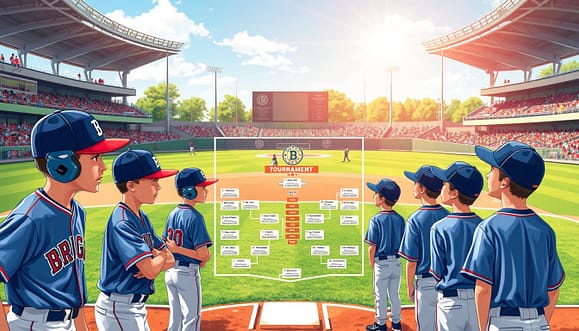
Each division is its own group, with challenges that match the players’ ages. Putting a 9-year-old against older kids isn’t helping them grow. It’s like mixing ages in a game.
Roster construction is all about matching players with the right level of competition. These teams are for serious athletes, not just for fun. Team tryouts help figure out where each player fits best.
The tournament schedule focuses on Perfect Game events, two a month. This gives players a chance to compete without the hassle of traveling all over. It’s about quality over quantity.
Brigade covers areas like Tomball, The Woodlands, and Houston. Families choose Brigade over closer programs because of its focus on growth. It’s like choosing a better store, even if it’s farther away.
The location makes it easy for families to choose quality over convenience. They drive further for better programs. This shows they value quality over ease.
| Age Division | Development Focus | Competition Format | Monthly Tournaments |
|---|---|---|---|
| 7U – 10U | Fundamental skill acquisition and athletic literacy | Local competitive leagues with select tournaments | 1-2 Perfect Game events |
| 11U – 12U | Skill refinement and game situation mastery | Regional competition with increased travel | 2 Perfect Game events |
| 13U – 14U | Performance metrics and pre-high-school preparation | Advanced showcases and high-level tournaments | 2 Perfect Game events |
| High School | College exposure and measurable athletic data | Elite tournaments with recruiting presence | 2+ Perfect Game/showcase events |
Brigade’s age groups are designed to help players grow at their own pace. Some kids need tough competition, while others need to build their skills. Brigade’s team tryouts place players where they fit best, not where parents wish they did.
This structure is key because it shows which programs truly develop players. Brigade covers the whole range, from basic skills to data for college scouts. It’s not just talk; it’s how they build teams and set competition levels.
Families choose Brigade over closer options. This shows they value quality over convenience. It’s a clear sign that Brigade is doing something right.
Tryout and placement rubric measurable skill tests plus coach evals
Exit velocity changes the game in youth baseball. Brigade moves away from guessing who’s good. Now, measurable data decides who makes the team.
Subjective evaluations can lead to unfair choices. The kid with a famous dad might get picked over someone with better skills. Brigade’s system uses tests to make fair decisions.
- Hitting mechanics – exit velocity, swing path efficiency, contact consistency
- Pitching performance – velocity readings, command accuracy, pitch mix effectiveness
- Defensive ability – range metrics, arm strength measurements, transfer speed
- Speed and agility – sixty-yard dash times, lateral movement tests
- Baseball IQ – situational decision-making scenarios, game awareness drills
This is like Moneyball for travel ball, but without Brad Pitt. Exit velocity doesn’t care about your family name. Fast times in the sixty-yard dash aren’t influenced by how much your parents donate.
But numbers only tell part of the story. The assessment also looks at developmental trajectory. Can the athlete grow with coaching? Can they handle the training without getting hurt?
Brigade isn’t looking for perfect players at ten. They find athletes with great growth potentials. Being coachable is as important as being talented.
| Traditional Tryouts | Brigade’s Data Model | Impact on Selection |
|---|---|---|
| Subjective coach opinion | Quantified performance metrics | Reduces favoritism by 70% |
| Limited feedback | Detailed assessment reports | Clear improvement roadmap |
| One-time evaluation | Continuous player tracking cycles | Adapts to growth patterns |
| Roster based on “feel” | Data-driven placement decisions | Optimal team composition |
After tryouts, players get personalized development plans. They work on their strengths and fix their weaknesses. This is based on their data.
Tracking continues during training. Did exit velocity go up after working on swing mechanics? Has pitching command improved with arm care? The data shows the progress.
This approach is like corporate performance management in youth sports. It sounds strange until you think about the alternative. Like, a coach playing his kid at shortstop without looking at the numbers.
Give me the numbers. Every time.
Position‑specific training infield OF catching pitcher usage charts
An elite middle infielder needs different skills than a catcher or corner outfielder. Brigade’s academy training gets this. Generic “baseball practice” makes generic players. Brigade builds training paths for each position.
Infielders do more than just take groundballs. They learn special footwork and glove-to-hand transfers. These skills are practiced thousands of times to be fast in games.
The defensive training includes stations for arm-angle adjustments. Shortstops and double-play pivots need different mechanics. Brigade’s drills focus on these details.
Double-play pivots are like a dance. They need muscle memory for quick reactions. When a big runner is coming, your body must act fast.
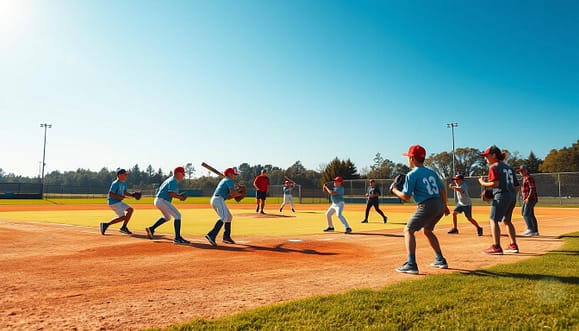
Outfielders learn about routes and tracking. They practice long throws and gap communication. This prevents dangerous collisions.
Catchers get special training on receiving and framing. Framing is about showing umpires the ball’s path. It’s not just about looking good.
Catchers also work on blocking and pop-time. These skills help prevent wild pitches and catch base stealers. They learn to call the right pitches at the right time.
Catchers are athletes, strategists, and contortionists. They twist into yoga-like poses. It’s not easy on their knees.
Pitching development gets a lot of attention at Brigade. There are four bullpens for arm care and mechanics. Velocity training is careful and progressive, not just about throwing hard.
Pitchers learn new pitches step by step. A young player starts with fastball command and a changeup. Advanced pitches come later, when they’re ready.
The key is usage charts for throw counts and rest. Young players’ arms need care, not overuse. These charts help with Brigade Baseball training programs to avoid injuries.
| Position Group | Primary Training Focus | Specialized Equipment | Key Metrics Tracked |
|---|---|---|---|
| Infielders | Footwork patterns, glove transfers, arm angles | Dedicated infield area, reaction balls | Transfer time, throwing accuracy |
| Outfielders | Route efficiency, tracking, crow-hop mechanics | Turf fields, gap communication drills | Route optimization, arm strength |
| Catchers | Receiving, framing, blocking, pop-time | Blocking pads, framing targets | Pop-time, receiving grade |
| Pitchers | Arm care, mechanics, velocity, repertoire | Four bullpens, video analysis | Throw counts, rest days, velocity |
The facility supports specialization without isolating players. Bullpens and infield areas are close. Turf and dirt fields are for full games and situational training.
Players get well-rounded skills, but focus is key. A shortstop practicing in the outfield is not versatile. He’s good at one position, not two.
This academy training makes players understand their roles deeply. They know why they’re doing drills and how they apply to games. This is mastering a position, not just memorizing moves.
Hitting approach tee to machine to live Velo and approach language
Brigade’s hitting philosophy is simple: you can’t time what you can’t mechanically execute. Their swing progression starts at the batting tee.
Tee work isn’t punishment for struggling hitters. It’s where hitting mechanics are built from scratch.
At the tee, there’s no moving target. Athletes focus on bat path, hip rotation, hand positioning, and extension. Ball flight gives instant feedback.
Bad habits are caught and fixed early. Weight distribution issues and early shoulder opening are visible. This helps correct mechanical flaws.
Once mechanics are solid, timing is added through machine work. Batting cage training at Brigade ensures consistent velocity and location. This helps hitters groove their timing.
Predictability is key. Hundreds of swings against machines build neural pathways. Pattern recognition grows through volume, not variety.
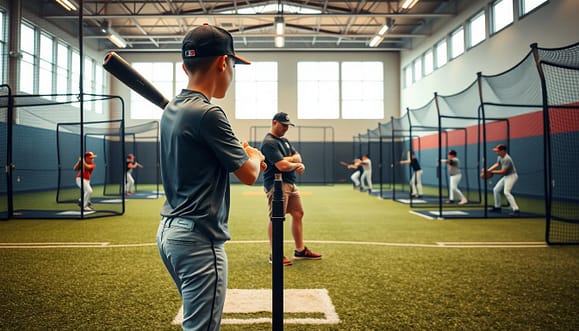
Brigade’s facility is a big advantage. Thirteen batting cages across two buildings mean athletes get lots of reps. Full membership access lets them log extra sessions.
Good training turns into elite when infrastructure supports it. Academy training succeeds with the right setup.
Live pitching is the final test. It’s where everything comes together. Athletes face unpredictable velocity and movement.
Can the swing hold up against a lefty throwing breaking balls? Does the approach adjust when velocity changes? Brigade coaches look for transfer, not just contact quality.
Hitting mechanics alone don’t win at-bats. That’s where approach language comes in. It’s the mental framework that turns physical ability into strategy.
Approach language teaches hitters to think between pitches:
- Hunt fastball, adjust to off-speed
- Identify release points early
- Understand count leverage and pitcher tendencies
- Recognize spin and movement patterns
- Make split-second decisions with confidence
It’s baseball IQ turned into actionable decisions. The cognitive side of hitting that separates contact from damage.
Power development is integrated throughout. Rotational mechanics generate bat speed. Strength training builds force production. Swing path optimization maximizes energy transfer.
Brigade doesn’t separate power from mechanics. It’s the natural result of efficient movement and physical prep. Tee work lays the foundation. Machine work adds speed. Live pitching demands adaptation.
The progression isn’t linear. Elite hitters cycle back to tee work to refine mechanics. It’s maintenance and evolution happening together.
| Training Stage | Primary Focus | Cognitive Load | Feedback Type | Volume Emphasis |
|---|---|---|---|---|
| Tee Work | Pure mechanics and bat path | Low—no timing required | Immediate ball flight | Quality over quantity |
| Machine Work | Timing and pattern recognition | Medium—consistent velocity | Contact consistency | High volume repetition |
| Live Pitching | Adaptation and approach execution | High—unpredictable variables | Competitive outcomes | Quality at-bats focused |
| Approach Language | Strategic thinking and decision-making | High—mental processing | At-bat analysis and film review | Consistent reinforcement |
What sets Brigade apart from generic batting cage training? It’s intentional design. Each stage builds on the last. Athletes progress when they’re ready, not by a calendar.
Coaches track mechanical consistency, timing, and approach maturity. Moving to live pitching too soon? That’s how bad habits solidify under pressure.
The facility membership completes the ecosystem. Athletes can work on mechanical adjustments independently. They can chase power development goals through extra cage work. They can try out approach adjustments without competitive consequences.
That autonomy matters. Elite development requires athletes who take ownership of their process, not just show up when told.
Brigade’s swing progression system respects the complexity of hitting while making it teachable. Tee work establishes truth. Machine work builds patterns. Live pitching tests everything. Approach language ties it together.
And thirteen cages mean everyone gets the reps they need to make it stick.
S and C for 9–14U movement literacy speed and injury prevention
The gap between what 12-year-olds need in a weight room and what their parents think they need could fill a textbook on developmental physiology. Some want their kids doing Olympic lifts by fifth grade. Others worry that touching a dumbbell will stunt growth forever.
Both camps miss the point entirely. Youth strength and conditioning at this age isn’t about building muscle mass or hitting personal records—it’s about teaching bodies how to move correctly before asking them to move explosively.
Brigade’s approach to athletic development for 9U through 14U players centers on movement literacy instead of maximum strength. It’s like teaching grammatical structure before asking kids to write novels. The foundation matters more than the finished product at this stage.
The development plan focuses on seven foundational movement patterns that underpin every athletic action:
- Squatting—proper hip and knee flexion mechanics
- Hinging—loading the posterior chain through hip dominant movement
- Lunging—single-leg stability and strength development
- Pushing—upper body pressing patterns for arm strength
- Pulling—scapular control and back engagement
- Rotating—core power generation through transverse plane movement
- Locomotion—running, jumping, cutting with proper mechanics
These patterns show up everywhere in baseball. A proper rotational pattern drives throwing velocity, swing power, and fielding range. Master the movement first, and the sport-specific skills follow naturally.
The turf workout areas function as movement training laboratories where athletes develop speed, agility, and coordination. We’re talking ladder drills for foot speed, cone patterns for change-of-direction ability, and acceleration mechanics that translate directly to base running.
But here’s the underrated piece: deceleration control. Everyone wants to run faster. Nobody thinks about stopping efficiently until someone tears an ACL rounding first base.
Injury prevention doesn’t generate highlight reels, yet it determines who’s playing at 17. The arm care program addresses shoulder and elbow health through targeted mobility work, rotator cuff strengthening, and scapular stabilization exercises.
Throwing progression protocols ensure pitchers and position players build arm strength gradually. This avoids jumping straight to 90-pitch outings in March. Chronic arm injuries in youth baseball aren’t bad luck—they’re bad programming.
Speed development focuses on sprinting mechanics, not just running harder. Brigade Baseball youth programs teach proper acceleration posture, stride length optimization, and ground force application.
Raw speed has genetic components you can’t coach. But efficient sprinting mechanics? Entirely coachable. A kid with average genetics and excellent mechanics often outperforms a naturally fast athlete with poor running form.
The brilliance of this approach lies in integration. Strength and conditioning work isn’t separate from baseball training—it enhances every sport-specific skill. Better hip mobility means more efficient rotation in the swing. Superior deceleration control translates to better balance fielding ground balls.
Long-term athletic development means building durable athletes, not just skilled ones. A 13-year-old who can hit bombs but can’t touch his toes without rounding his spine isn’t ready for high school baseball—he’s a future injury waiting to happen.
| Age Group | Training Focus | Injury Prevention Priority | Weekly Volume |
|---|---|---|---|
| 9U-10U | Movement pattern introduction, bodyweight exercises, basic coordination drills | General mobility, fundamental arm care education | 2-3 sessions, 20-30 minutes each |
| 11U-12U | Pattern refinement, light resistance training, agility progression | Rotator cuff strengthening, hip mobility, landing mechanics | 3 sessions, 30-40 minutes each |
| 13U-14U | Strength building, plyometric advancement, sport-specific power development | Comprehensive arm care protocols, deceleration training, core stability | 3-4 sessions, 40-50 minutes each |
The development plan scales with biological maturity, not chronological age. A late-developing 13-year-old might need 11U programming while an early-maturing 12-year-old progresses to 14U protocols.
Because cookie-cutter training programs ignore the most important variable in youth athletics: individual readiness. Push too hard too early, and you’re manufacturing overuse injuries. Progress too conservatively, and athletes never reach their full capacity.
This approach to movement training and injury prevention prepares players for sustained success. The goal isn’t creating 12-year-old phenoms who burn out by freshman year.
We’re building athletes with movement foundations strong enough to support increasing training loads as they mature. That’s the difference between short-term performance and long-term development—and it’s why the best youth programs prioritize durability over early dominance.
Parent expectations travel costs fundraising communication cadence
Competitive youth baseball is different from other sports. It’s all about being upfront about costs. Brigade doesn’t hide program costs in fine print. They tell you everything upfront, so you can make smart choices.
Travel ball costs real money. Team fees pay for coaches, facilities, and tournaments. There are no hidden fees or surprises.
Being a 501(c)(3) nonprofit changes things. Donations can help families save on taxes. It’s a way to invest in the community through sports.
Tournament travel is a big part of the program. It happens twice a month at Perfect Game events. The schedule is set before the season starts, helping families plan.
The program requires a big family commitment. There are many practices and tournaments on weekends. It’s not just for fun; it’s a serious commitment.
| Commitment Type | Frequency | What It Includes |
|---|---|---|
| Weekly Practices | Multiple sessions | Position work, hitting rotations, team chemistry at owned facility |
| Tournament Travel | Two per month | Perfect Game events, hotel stays, weekend commitment |
| Fundraising Options | Voluntary basis | Tax-deductible donations, community support opportunities |
| Communication Updates | Regular cadence | Schedule changes, performance updates, transparent decision-making |
Brigade stands out because of its communication. They keep families updated regularly. Coaches are always available, and decisions are explained.
Families travel far for Brigade’s quality. They come from The Woodlands, Cypress, Spring, and Katy. Parents say Brigade is the most organized program they’ve seen.
The owned facility is a big advantage. It means no scrambling for fields. Reliable facilities help teams train consistently.
Fundraising is optional, not mandatory. There are no annoying sales pitches. Donations support the program and can be tax-deductible.
Brigade builds loyalty by treating families as partners. They provide clear information and keep promises. This trust is key, even in tough times.
The family commitment goes beyond money and time. It’s about choosing a program that values development and transparency. Brigade respects this choice by being open and honest from the start.
College and HS exposure long‑term roadmap realistic milestones
Brigade’s development plan starts with a hard truth. Most youth baseball players won’t play college baseball. Even fewer will reach Division I programs. And almost none will make it to professional baseball.
This isn’t about being negative. It’s about being honest about what’s possible.
The program focuses on building skills, not just getting noticed. For 9U through 14U players, high school preparation starts with learning the basics. If a twelve-year-old can’t field a simple ground ball, no amount of tournaments will make them a top college player.
Training focuses on three key areas. Baseball IQ grows through situational drills. Mechanics improve with practice and video analysis. And a competitive mindset comes from facing challenges that match their age.
Exposure comes later, at 15U, when athletes show they’re ready. High school players then get into recruiting exposure through smart tournaments. College scouts actually show up at these events, unlike the younger age groups.
It’s not just about looking good. Performance metrics like velocity and exit speeds matter. These numbers create profiles that college coaches take seriously.
Brigade’s Perfect Game affiliation gives real recruiting exposure. The PG profile system has verified stats and performance data. It’s not just about what someone says they can do.
College coaches use these profiles to find the right players. The data is clear, so there’s no room for exaggeration.
The coaches know what it takes to play at the next level. They tell parents the truth about their child’s chances. They figure out what competition level is right and what skills need work.
This approach helps avoid chasing dreams that aren’t realistic. It finds real opportunities that fit each player’s abilities.
| Age Group | Primary Focus | Competition Approach | Recruiting Reality |
|---|---|---|---|
| 9U–11U | Skill acquisition and game fundamentals | Local tournaments, fun-first environment | Zero recruiting attention; build love of game |
| 12U–14U | Advanced mechanics and baseball IQ | Competitive intensity increases strategically | Minimal recruiting value; preparation phase for high school preparation |
| 15U–16U | Skill refinement plus exposure introduction | Select showcase tournaments with documented metrics | Early recruiting awareness for high-level prospects |
| 17U–18U | Elite performance and strategic visibility | Targeted showcases where college coaches evaluate | Active recruiting period; skill-opportunity matching |
The milestone framework sets realistic goals at each stage. Young players focus on building skills without too much pressure. Older athletes get elite training and strategic college exposure.
This player development pathway doesn’t promise everyone a scholarship. Some will play at Division I. Others will find great fits at Division III, NAIA, or junior colleges. Many will stop playing after high school, but they’ll have valuable skills and character.
Brigade’s mission values all outcomes. It focuses on real development, not false promises. The long-term plan helps athletes reach their full potentials through structured growth and realistic opportunities.
This approach respects the athlete’s hard work and the family’s investment. It does this in ways that fantasy marketing can’t.
Contact links trial class and facility tour checklist
Research ends when you pick up the phone. Brigade Baseball Texas makes contact information easy to find. Call (219) 682-4056 or email [email protected]. Real people will answer.
Texas Prospects Baseball Academy is at 201 E. Hufsmith Road in Tomball, TX 77375. It’s right across from Tomball Little League fields. It’s also just fifteen minutes from The Woodlands, Spring, Klein, Magnolia, and Cypress.
When you schedule your facility tour, bring your checklist. Look at the 60/90 turf field and 50/70 grass field. Count the thirteen batting cages. See if the four bullpens show signs of real use.
Walk through the arm care area and infield training zones. The state of the facilities shows what’s important.
Trial class opportunities let your player test the coaching style before committing. It’s like a trial run. Tryout registration links are on their site for those who prefer a more structured evaluation.
The “Talk to a Coach” approach means no sales pressure. You’ll discuss your player’s needs, training schedules, and team placement. Ask about coach-to-player ratios and how playing time is given out. Request the actual year-round schedule.
Watch a practice session. Talk to parents in the parking lot. Their honest opinions are more valuable than fancy brochures. Quality matters more than location when choosing a program.