

Venue Selection affects more than the bracket. For Texas youth baseball hosts, the right complex can shorten delays, keep families on site, protect field conditions, and make a tournament feel organized from the first pool game through the last trophy photo. The wrong site can turn a strong team draw into a weekend of late starts, backed-up parking, overheated families, and coaches asking where the next field is.
A home field advantage in youth baseball is not only about sleeping in your own bed. It is about knowing the gates, the dugouts, the bullpen space, the drainage patterns, the concession rhythm, and the nearest safe place for families when weather rolls in. Tournament directors who treat the venue as part of the competition plan usually make better choices than directors who only count diamonds and hope the rest works itself out.
Why Venue Selection Shapes Tournament Weekends
Venue Selection Starts With The Draw
A tournament site has to match the size of the field. A small event can survive with fewer diamonds if game times are realistic and warmup space is managed. A larger event needs enough fields, traffic lanes, restrooms, staff access, and staging room to avoid turning every inning change into a crowd-control problem. The Orioles reported that the Wilson Premier Championship East in Sarasota attracted 240 teams Orioles report. That kind of team count shows why tournament planning has to start with venue capacity, not just brand appeal.
For Texas hosts, the lesson is practical. If a complex cannot handle the number of teams, families, umpires, trainers, and vendors expected on site, the schedule will show it. Long gaps, late-night finishes, and packed common areas usually trace back to a mismatch between the event and the site. A tournament can still be competitive, but the family experience suffers when the facility is stretched past its working limits.
Economic Pull Without Overpromising
Youth baseball tournaments can help restaurants, hotels, fuel stops, grocery stores, and local vendors, but the venue has to support that traffic. A site with poor entry flow or limited parking may push families away between games. A site with shade, restrooms, concessions, and nearby services gives families fewer reasons to leave. That matters for towns trying to connect baseball weekends with local spending.
This is where sports-first planning fits local baseball. Hosts should ask whether the site supports the tournament and the community at the same time. Can teams get in and out without blocking local roads? Are hotels within a reasonable drive? Is the complex easy for grandparents and younger siblings to manage? For a broader Texas planning angle, our look at Texas baseball tournaments covers how host cities can build support around teams, families, volunteers, and fields.
Field Layout, Parking, And Family Flow
Diamonds, Warmup Space, And Turn Times
A good baseball venue is more than a set of fences and bases. Tournament directors need to look at how each diamond works under pressure. Are dugouts protected and sized for youth rosters? Is there a safe bullpen or soft-toss area that does not cross spectator paths? Can teams warm up without drifting into foul-ball zones? Are fields close enough for families with siblings playing on different diamonds, but not so close that every foul ball becomes a safety concern?
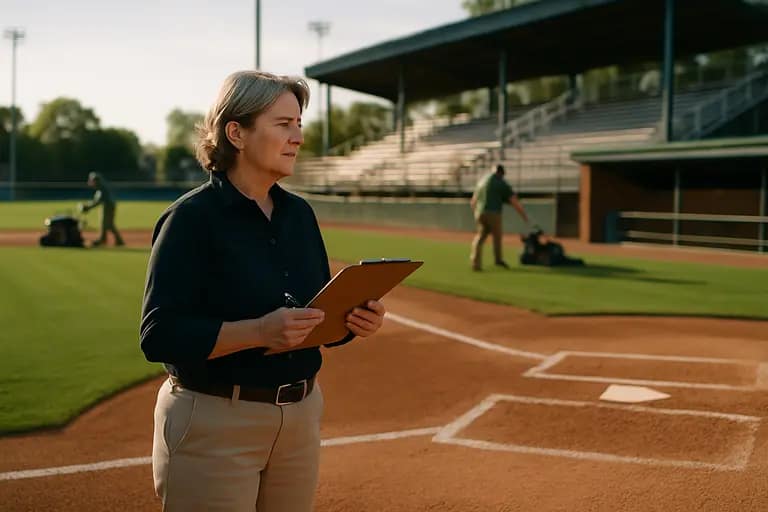
Turn time is another facility issue. If fields are spread out with limited maintenance access, dragging and lining between games takes longer. If carts, rakes, chalk, water, and staff are positioned well, the schedule has a better chance. This is where equipment planning and site layout meet. A field crew can only work as fast as the complex allows. Hosts should walk the site before committing and time the routes from field to field, field to restroom, field to parking, and field to medical access.
Parents Need More Than A Seat
Parents judge a venue through small details. They notice whether a stroller can move from Field 1 to Field 4. They notice if the restroom line is longer than the half-inning. They notice whether grandparents can find shade. They notice if a foul ball can reach a picnic area. None of those details show up in a bracket, but all of them shape whether families want to return.
For Texas baseball families, heat and distance can make those details feel bigger. A venue with open walkways, shade opportunities, clear field numbering, and logical parking reduces stress. A venue with confusing access points creates problems before the first pitch. Tournament hosts should think like a parent carrying a chair, a cooler, a bat bag, and a younger sibling’s snack. If that walk feels rough at 8 a.m., it will feel worse after three games.
Facility Ownership And Long-Term Control
Permanent Homes Change Operations
Dedicated facilities can give leagues and associations more control over scheduling, maintenance standards, sponsorship placement, and tournament identity. The Washington Post reported in 2004 that the Soccer Association of Columbia/Howard County invested $5.75 million in an eight-field complex Washington Post report. That example was not a baseball project, but it shows the value groups can see in a permanent home for teams and hosted events.
For baseball, control matters because fields wear down fast. Mound clay, batter’s boxes, base paths, grass edges, backstop netting, and bullpen areas all need regular attention. A borrowed or shared venue may limit what a tournament host can repair, mark, store, or upgrade. A dedicated site can create better routines for pre-event checks, equipment storage, irrigation timing, and field recovery after rain.
That does not mean every Texas youth baseball group needs to own a complex. Many should not. Land, lighting, insurance, staffing, and maintenance can become heavy costs. But every host should understand the tradeoff. Renting may lower the upfront burden, while ownership may offer more control. The best choice depends on team volume, local support, maintenance skill, and whether the venue can stay busy outside one tournament weekend.
Why Venue Selection Matters For Texas Baseball
A Practical Texas Checklist
Treat Venue Selection as a baseball operations decision, not a logo decision. A recognizable complex helps, but coaches and families remember whether games started on time, fields played fair, players had safe warmup room, and spectators could manage the day without constant frustration. Before signing a facility agreement, tournament directors should walk the site with a coach, a field maintenance lead, and someone thinking only about family movement.
- Field Fit: Confirm age-appropriate dimensions, safe dugouts, working backstops, and enough space for warmups.
- Schedule Capacity: Match the number of teams to realistic game slots, field prep time, and daylight or lighting.
- Family Access: Check parking, restroom location, shade, seating areas, and paths between fields.
- Maintenance Readiness: Review rakes, drags, chalk, drying materials, irrigation access, and staff responsibilities.
- Weather Response: Identify shelter options, communication points, and field recovery limits before the event starts.
- Local Support: Consider nearby food, lodging, fuel, and medical access for traveling families.
The best youth baseball venues make the hard parts easier. They give players a fair surface, coaches a workable schedule, umpires a manageable setup, and families a place where the long day feels planned. For Texas communities trying to host better tournaments, the field is not just the backdrop. It is the structure that decides how the whole weekend runs.